The BFCM 2026 calendar
The main weekend runs from Thanksgiving on Thursday 26 November to Cyber Monday on 30 November, but the sale should start well before it. We plan BFCM in 3 phases with teasers between them, because the people who buy early are often people who would not have bought on the day itself.
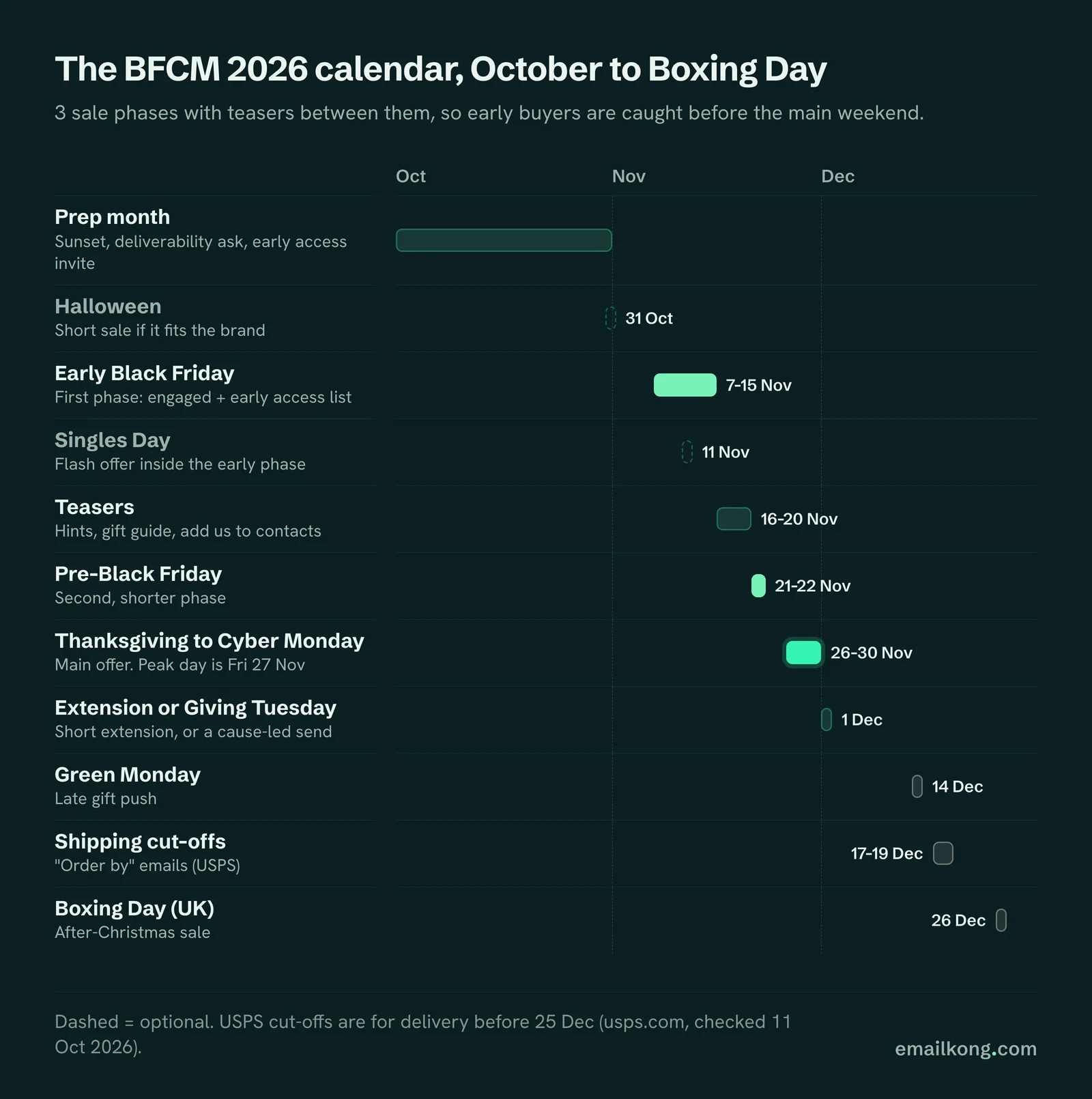
| Date (2026) | Moment | What to send |
|---|---|---|
| 1-31 Oct | Prep month | Sunset unengaged profiles, deliverability ask, early access invite (join by reply) |
| Sat 31 Oct | Halloween | Optional short sale for brands that fit it |
| 7-15 Nov | Early Black Friday | First sale phase to engaged customers and the early access list |
| Wed 11 Nov | Singles Day | Optional flash offer inside the early phase |
| 16-20 Nov | Teasers | Hints at the main offer, gift guide, "add us to your contacts" |
| 21-22 Nov | Pre-Black Friday | Second, shorter sale phase |
| Thu 26 Nov | Thanksgiving (US) | Main offer opens for the early access list or everyone |
| Fri 27 Nov | Black Friday | Peak day: several emails and 1-2 SMS to engaged tiers |
| Sat 28 - Sun 29 Nov | Weekend | Bestsellers, bundles, gift-with-purchase reminders |
| Mon 30 Nov | Cyber Monday | Last full day of the main offer, last-hours email and SMS |
| Tue 1 Dec | Extension or Giving Tuesday | A short extension, or a cause-led send with no discount |
| Mon 14 Dec | Green Monday | Late gift push before shipping cut-offs |
| Mid Dec | Shipping cut-off | "Order by" emails. USPS recommends Ground Advantage and First-Class Mail by Thu 17 Dec, Priority Mail by Fri 18 Dec and Priority Express by Sat 19 Dec for delivery before 25 Dec (usps.com, checked 11 Oct 2026). UPS and Royal Mail had not published 2026 dates on that day, so take those from the carrier pages |
| Sat 26 Dec | Boxing Day (UK) | After-Christmas sale for UK lists |
Brands selling in the UK and EU can skip Thanksgiving framing and open the main offer on Thursday with a "before tomorrow" angle instead.
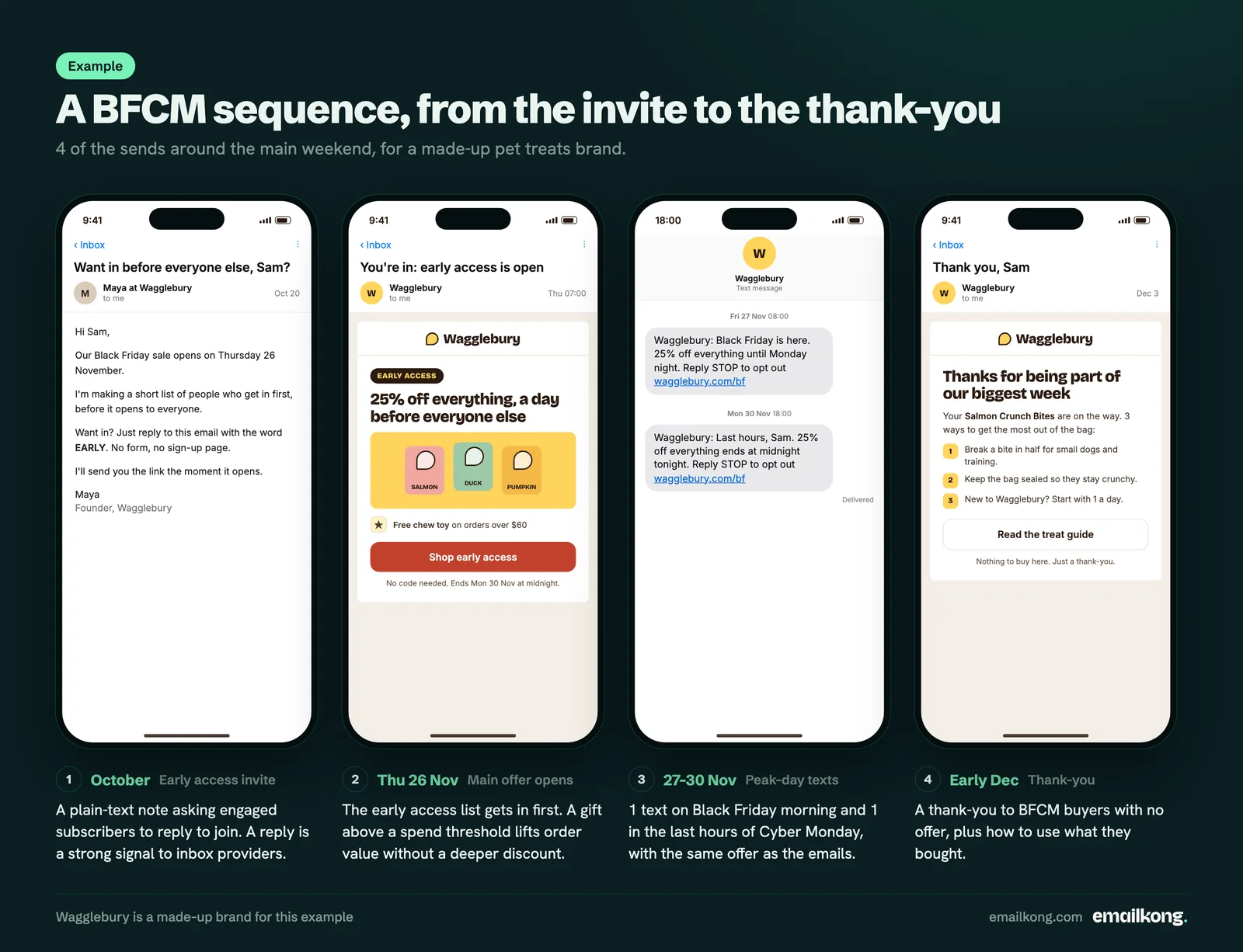
Start in October with the list and deliverability
The weeks before the sale decide whether your Black Friday emails reach the inbox. Inbox providers judge you on recent engagement and complaints, and the biggest risk is a brand that mails 3 times its normal audience on Black Friday morning.
What to do in October:
- Check authentication. Google's sender rules ask bulk senders to set up SPF, DKIM and DMARC, offer one-click unsubscribe and keep spam complaints below 0.3% in Postmaster Tools. Use a branded sending domain in Klaviyo.
- Run a sunset. Email people who have not opened or clicked in months, ask if they still want to hear from you, and suppress the ones who stay silent.
- Ask for engagement. A plain-text email from the founder asking people to reply, or to move you to the Primary tab, gets replies and clicks from your best subscribers before volume goes up.
- Build an early access list. Ask engaged subscribers to reply to join. A reply is a strong signal to inbox providers, and the list becomes your first Black Friday audience.
- Raise volume gradually. If you plan to mail medium and low engagement groups in November, add them a few weeks early with a few non-discount sends so the first email they see is not a sale blast.
Segments: who gets which send
Send every email to your most engaged tier and widen the audience only on tentpole days. On every account we run, campaigns go to engagement tiers rather than the whole list, and reach is controlled by which tiers are included.
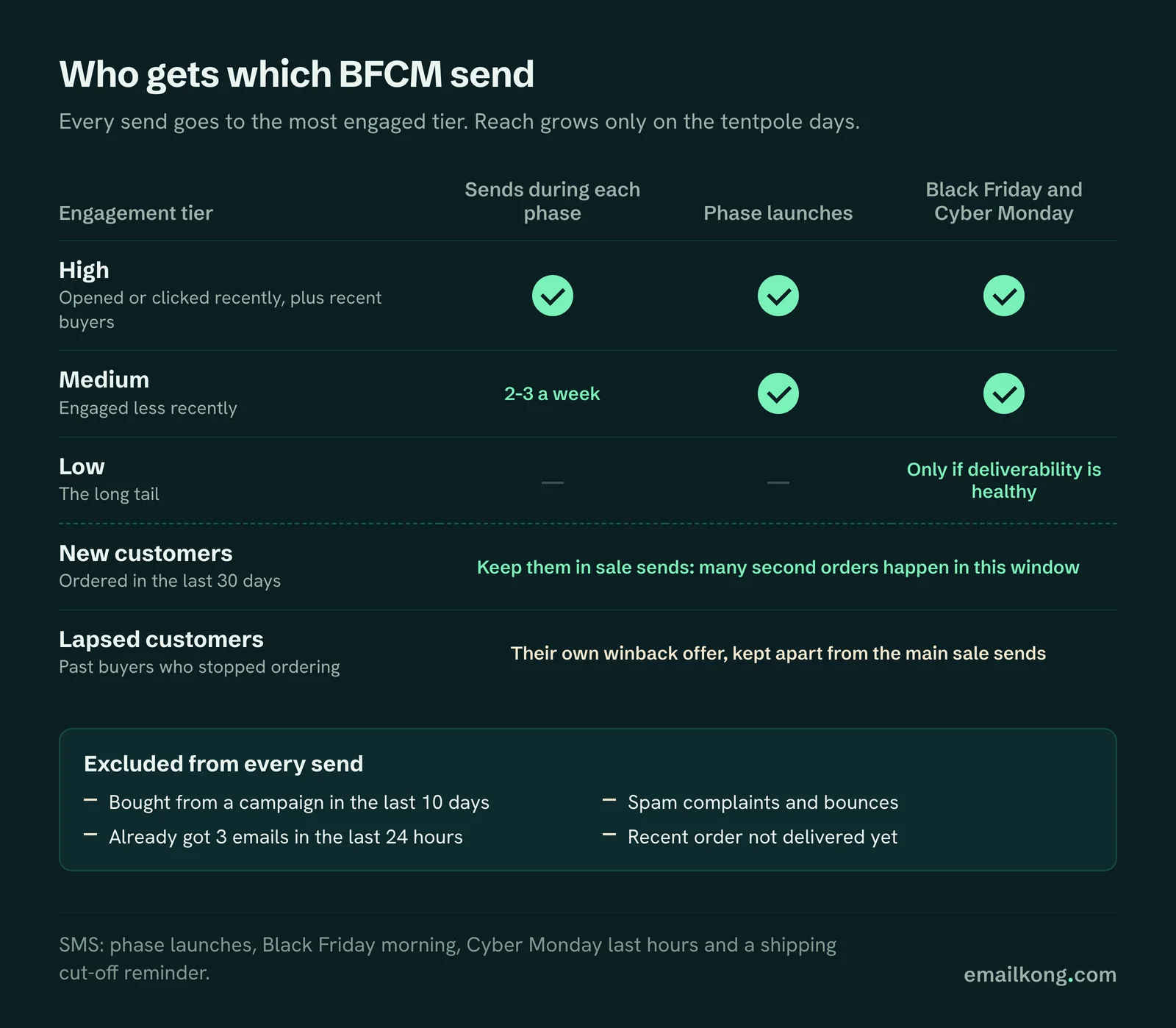
- High engagement (opened or clicked recently, plus recent buyers): every campaign in the period.
- Medium engagement: added for sale launches and 2-3 sends a week during the phases.
- Low engagement: only on the biggest days, such as Black Friday and Cyber Monday, and only if your deliverability is healthy.
- Lapsed customers: their own winback offer, kept separate from the main sale sends.
- New customers from the last 30 days: keep them in sale sends, since many second orders happen in that window.
We use the same 4 exclusions on every send: people who bought from a campaign in the last 10 days, spam complaints and bounces, anyone who already got 3 emails in the last 24 hours, and recent customers whose order has not been delivered yet. More exclusions than that tends to shrink the audience without anyone noticing.
SMS timing. SMS costs per message and has a smaller audience, so save it for moments that matter: the launch of each phase, Black Friday morning, Cyber Monday last hours and a shipping cut-off reminder. 1-2 texts on the peak days is enough for most brands. Set quiet hours in Klaviyo and check the rules for each US state you send to.
Email count. Outside the main weekend, we keep to 1 email a day, with 2 only on the first or last day of a sale. On Black Friday itself we send several emails across the day to the most engaged tiers, and each one says something new: the launch, bestsellers, the gift, then the last hours.
Offers that protect your margin
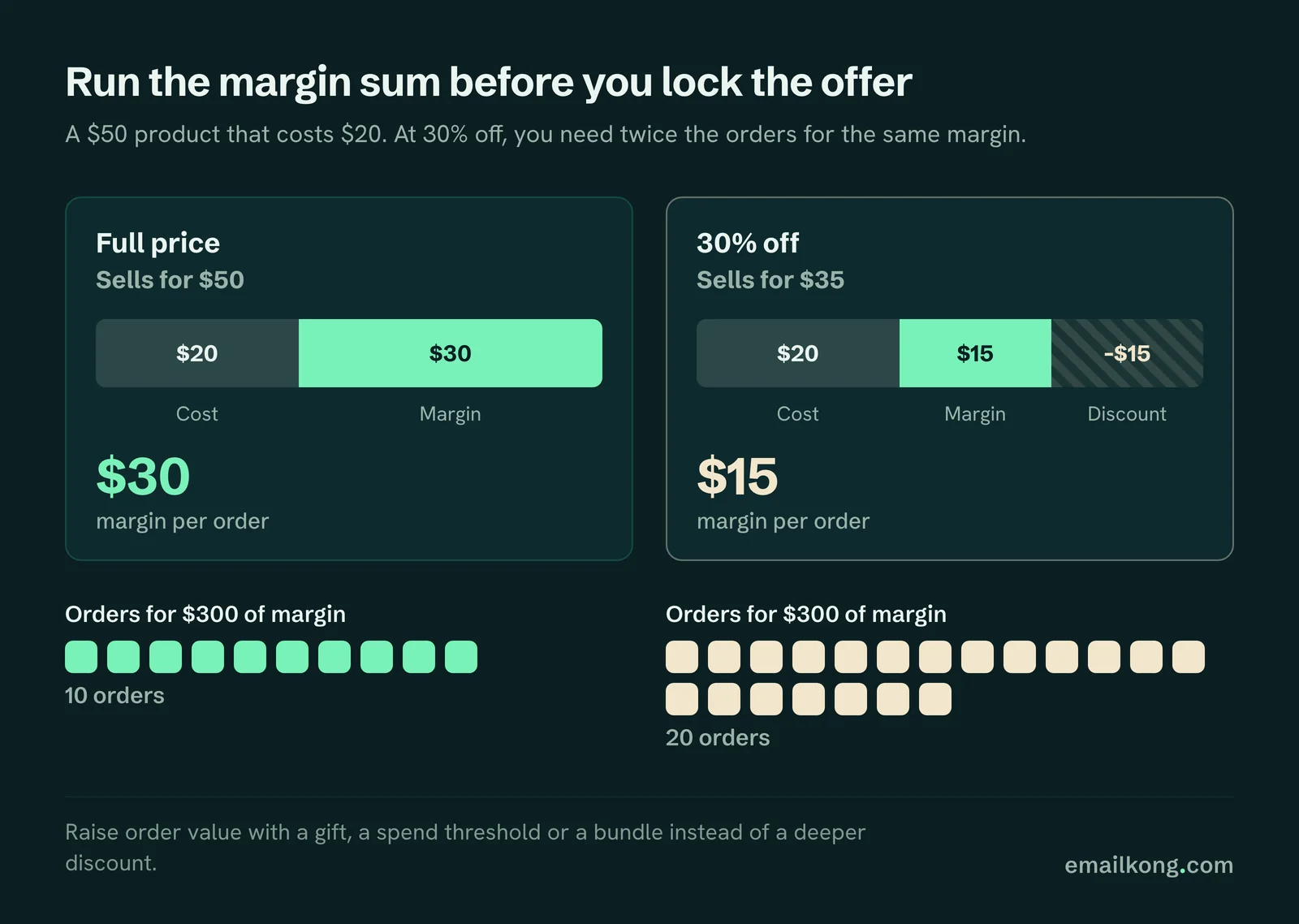
Pick an offer you can afford to sell at volume, then use gifts, thresholds and bundles to raise order value instead of going deeper on the discount. A deeper discount needs a lot more orders to make the same profit.
A simple check: a product that sells for $50 and costs $20 makes $30 of margin. At 30% off it sells for $35 and makes $15, so you need twice as many orders to earn the same margin. Run that sum for your bestsellers before you lock the offer.
Ways to raise order value without going deeper:
- Gift with purchase above a spend threshold.
- Tiered offers, such as 20% off under $75 and 25% off above it.
- Sale-only bundles of products people already buy together.
- Early access to the main offer instead of a separate, bigger discount.
- A short extension on Tuesday 1 December for people who missed Cyber Monday.
Decide the offer and every code before Halloween, so emails, SMS, pop-ups and the site all say the same thing on the day.
Flows to pause or adjust during the sale
Your flows keep running during BFCM, and some of them will contradict the sale if you leave them as they are. Review each one in the first week of November.
- Welcome flow. A 10% welcome code looks weak next to a 25% sitewide sale. Point new subscribers to the sale during the sale window.
- Abandoned checkout and cart. Mention the sale and its end date, and make sure the code in the email still works.
- Browse abandonment. Traffic and triggers jump, so keep Smart Sending on and check that the flow is not looping on bots or crawlers.
- Winback and discount flows. Pause the discount emails if the same people are already getting your sale campaigns.
- Post-purchase. Keep it running, but delay cross-sell emails for sale buyers so they do not get a full-price offer 2 days after buying on discount.
- Sunset flow. Keep it on. It protects your sender reputation during the busiest weeks of the year.
Subscription brands: don't discount subscribers into churn
Keep active subscribers out of one-time discounts that beat their subscription price. If a public 30% off is better than the 15% they get as a subscriber, some will cancel and buy one-time, or wait for the next sale.
What we do instead for brands on Loop:
- Give subscribers their own offer, such as a free gift added to their next order, a bonus product or early access to new products.
- Offer add-ons at renewal through Loop upsell profiles, so subscribers add sale items to an order they were going to receive anyway.
- Use the sale to win back cancelled subscribers, with a separate send to people who cancelled in the last few months.
- Prepare the cancel flow for January. Across the subscription brands we run on Loop, "I have enough or too much product" is already the #1 cancel reason, at about 23% of cancel attempts. Subscribers who stock up in a sale are likely to hit it, so make skip and slower frequency easy to find before December.
- Turn sale buyers into subscribers in the post-purchase flow, with the subscribe option and its price shown clearly.
Check that sale codes behave the way you expect on subscription products before the sale starts. A code that applies to every future renewal can cost far more than one discounted order.
After BFCM: keep the new customers
The weeks after Cyber Monday decide whether BFCM buyers become repeat customers. Most of them bought on discount, often for the first time, so the job is a second order at a smaller discount or none.
- Welcome new customers properly with a post-purchase flow that explains how to use the product and what to buy next.
- Run December as its own calendar: gift guides, shipping cut-offs, last-minute gift cards, then Boxing Day and New Year.
- Send a thank-you to BFCM buyers in early December with no offer.
- Watch unsubscribes and complaints for 2 weeks after the sale, then pull back to high and medium tiers.
- Plan January before December ends: replenishment reminders, subscriber winback and a sunset for anyone who only opened during the sale.
EK proof
Email Kong is a Klaviyo Master Platinum Partner and an official Loop partner, and has worked with 140+ DTC brands over 5 years. Clients have $59M+ in revenue attributed to Klaviyo. This year we are running Q4 calendars for 30+ client brands with the segment setup described above. Results we can share, measured as Klaviyo's share of total store revenue:
- Kaori (women's health, subscription): Klaviyo went from 3.3% to 19% of store revenue. Flow revenue grew 17.7x.
- Penrose Skin (skincare, subscription): Klaviyo's share went from 15.2% to 23.2%.
- TwoPackBag (travel bags): $1.38M in flow revenue in 90 days. Klaviyo's share went from 17.3% to 23.7%.
- KittySpout (pet, subscription): 46% of store revenue comes from Klaviyo.