
Why supplement retention is its own job
Supplements sit inside the largest subscription category, and a lot of the churn happens before the product has had time to work. Recharge's 2026 trend report puts health and wellness at about 11.2M active subscribers, the most of any category, with supplements roughly 50% of that and the fastest-growing slice.
Eightx puts monthly churn for supplement subscriptions at 5-8%, with under 5% strong and over 10% a problem. Across replenishment subscriptions, it estimates 60-70% of subscribers are lost between order 1 and order 3. For a supplement, orders 1 to 3 cover the first 2-3 months, when the customer is still waiting to notice a change, so the emails in that window carry most of the retention work.
Supplement brands also have rules other categories don't. What you can say about a product is limited, and paid social restricts health claims, so more of the selling moves into email, where the same rules still apply.
Reorder timing by serving count
Time reorder emails from the serving count and daily dose, then send the reminder about 7-10 days before the customer runs out. Days of supply is servings in the pack divided by servings per day.
| Pack and dose | Days of supply | Reorder email on day |
|---|---|---|
| 30 servings, 1 a day | 30 | 20-23 |
| 60 capsules, 2 a day | 30 | 20-23 |
| 60 servings, 1 a day | 60 | 50-53 |
| 90 servings, 1 a day | 90 | 80-83 |
| 30 servings, 2 a day (loading or double dose) | 15 | 8-10 |
In Klaviyo this means one replenishment flow per pack size, or one flow with branches on the product ordered. For subscribers, the same numbers set the default frequency in Loop. A customer on a 30-day pack who takes 1 serving most days ends up with a growing pile, and "enough stock" becomes their cancel reason.
"I didn't notice a difference" and the first 30 days
Most supplements need regular use over weeks before a customer can judge them, so the first 30 days of email should explain how to take the product and what to expect when. Customers who skip doses or expect results in a week tend to cancel with "I didn't notice a difference".
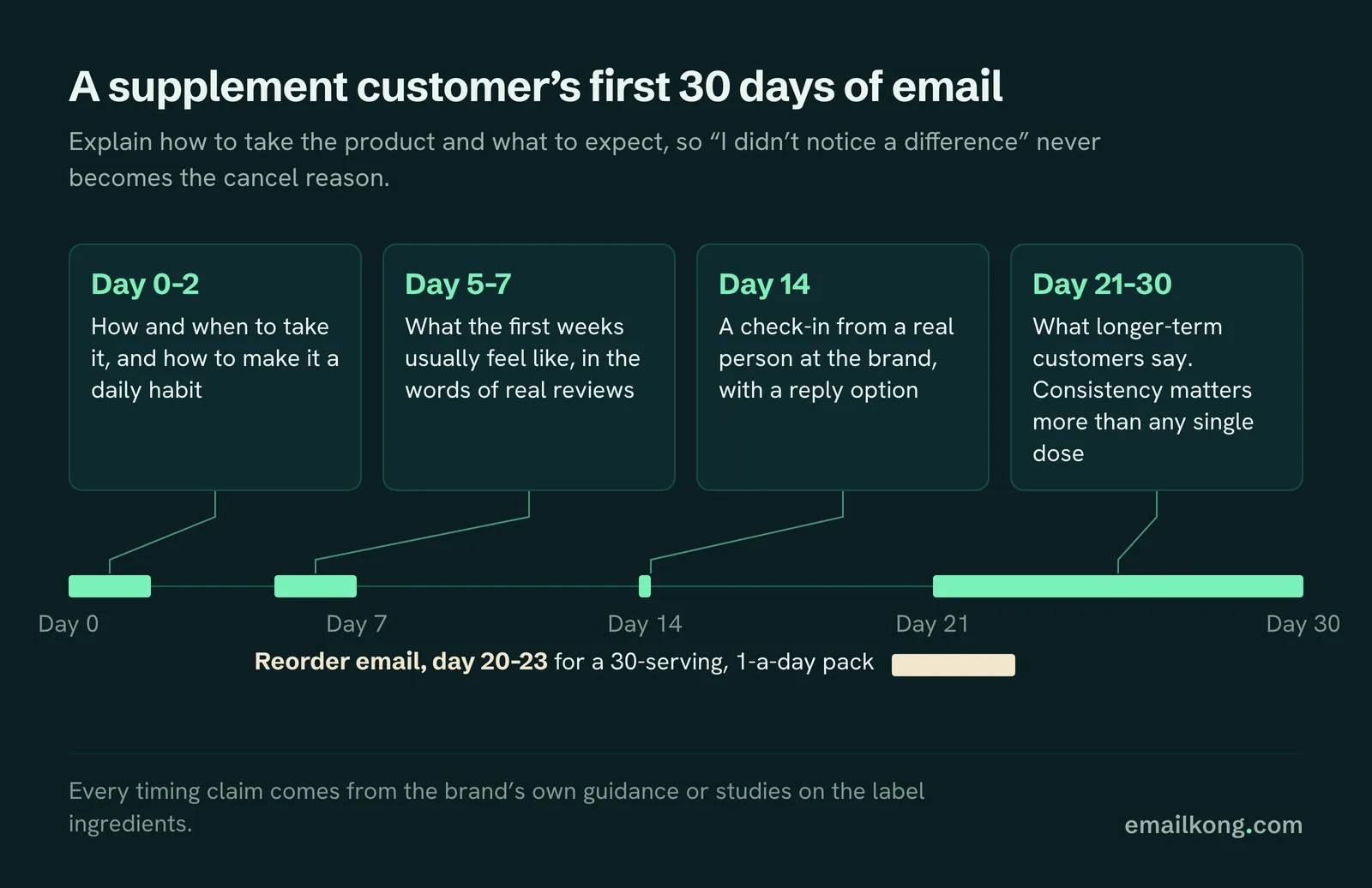
The onboarding series we build for a new supplement customer:
- Day 0-2. How and when to take it, with food or without, and how to make it a daily habit.
- Day 5-7. What the first weeks usually feel like, in the words of real reviews.
- Day 14. A check-in from a real person at the brand, with a reply option for questions.
- Day 21-30. What longer-term customers say, and a reminder that consistency matters more than any single dose.
Every timing claim in those emails has to come from the brand's own guidance or studies on the label ingredients. If the product page doesn't say when results show, the email doesn't either.
In the cancel flow, "I didn't notice a difference" is answered with how-to-use help and a support option before any discount.
Claims in supplement emails
Supplement emails follow the same claim rules as the product page. In the US, structure/function claims such as "supports restful sleep" are allowed with the FDA disclaimer, and disease claims such as "treats insomnia" are not. The FTC expects health claims to be backed by competent and reliable scientific evidence.
The checks we run on every supplement email before it goes to design:
- Every benefit line matches a claim already on the product page or label.
- Words like treats, cures, prevents, heals or reverses never appear.
- Reviews quoted in an email are real, quoted as written and typical of the product. The brand is responsible for reviews it chooses to send.
- Before-and-after content follows the same rules as a written claim.
- The disclaimer goes in the footer of every email that makes a structure/function claim.
None of this is legal advice. Brands with a regulatory advisor should have them sign off the claim list once, and we write from that list.
Stacking, bundles and new formats
A second product raises order value and gives a subscriber more to miss if they cancel, so the post-purchase flow should suggest the product that pairs with what they bought. A stack works when each product has its own job and the email explains how to take them together.
What we set up for stacks:
- Pairings in the post-purchase flow. One suggestion per product, chosen from what customers already buy together in Shopify data.
- Bundles in Loop. Subscribers can add a second product at renewal through upsell profiles, without placing a new order.
- Add-on at the upcoming order email. A one-click add-on to the next shipment.
Some categories are growing fast enough to plan for. SPINS data shows creatine sales up 71.9% in the 52 weeks to 30 Nov 2025, and women made up 30% of GNC creatine purchases, up from 18% in 2020. GLP-1 use among Americans went from 10% in 2024 to 18% in 2025 (Innova), and brands are building products for people on GLP-1s, though there is no solid sales data for that category yet. A brand launching into either should segment its list by gender and goal first, so the launch email reaches the people it was made for.
Supplement cancel reasons
Supplement subscribers cancel most for having too much product, then for price. At one supplement and women's health brand we run on Loop, "enough stock" is 23% of cancel reasons and "too expensive" 15%. At another, "too much product" is 33%.
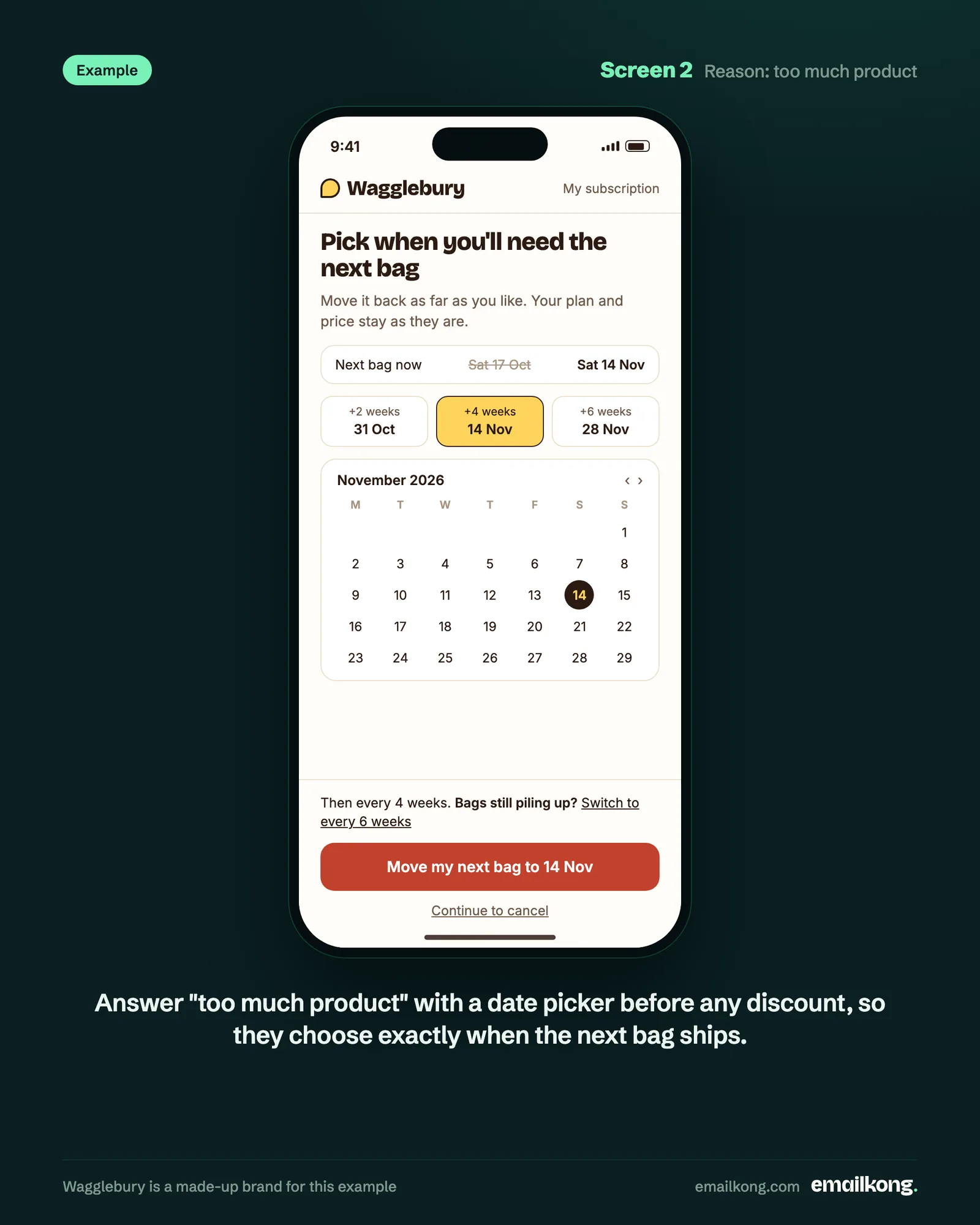
Each reason gets its own answer:
- Enough stock or too much product. Skip the next order or move to a slower frequency.
- Too expensive. One clear discount on the next order, or a longer gap between orders.
- I didn't notice a difference. How-to-use help, a support chat and a reminder of how long the product takes.
- I want to try something else. A swap to another product in the range.
EK proof
We run Klaviyo and Loop together for supplement and women's health brands.
- Kaori (women's health): Klaviyo went from 3.3% to 19% of store revenue. Flow revenue grew 17.7x.
- Across the subscription brands we run on Loop, "I have enough or too much product" is the #1 cancel reason, at about 23% of cancel attempts in the last 90 days (20,000+ cancel-flow events).
- About 1 in 5 people who start canceling give no reason at all, so we count saves per reason.