Why pet retention works differently
Pet products run out on a schedule set by the animal. A bag of food, a tub of chews or a pack of filters lasts as long as the pet's size, appetite and number of pets in the house allow, so a single reorder timer for every customer sends reminders too early to some and too late to others.
Pet is one of the most subscription-heavy categories online. Chewy reported that Autoship was 83.3% of its sales in FY25. For private DTC pet brands, Eightx estimates subscriptions at 35-65% of revenue. US online pet food and supply sales were $28.8B in 2025 (IBISWorld), and US pet supplements about $1.32B (Future Market Insights). When that much revenue repeats, the work that keeps subscribers ordering is where most of the money sits.
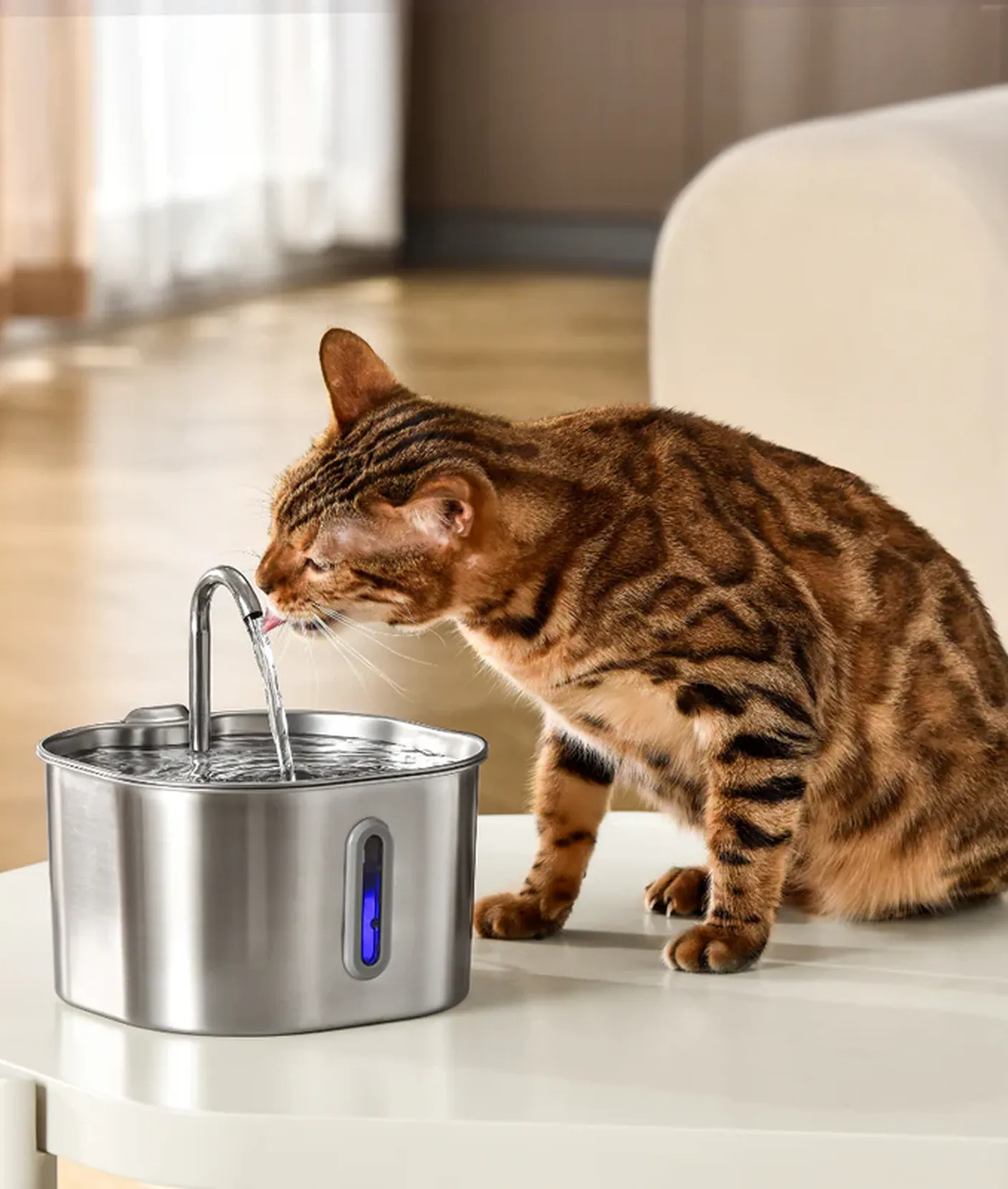
Whether the product gets used is up to the pet. A cat that ignores a new fountain or a dog that refuses a chew can end a subscription, so retention for pet brands has to plan for that from the first order.
Reorder timing by bag size and pet weight
Set reorder timing from how many days a product lasts for that pet, then send the reminder about 7-10 days before it runs out. Days of supply comes from the pack size and the daily amount on your feeding or dosing guide for the pet's weight band.
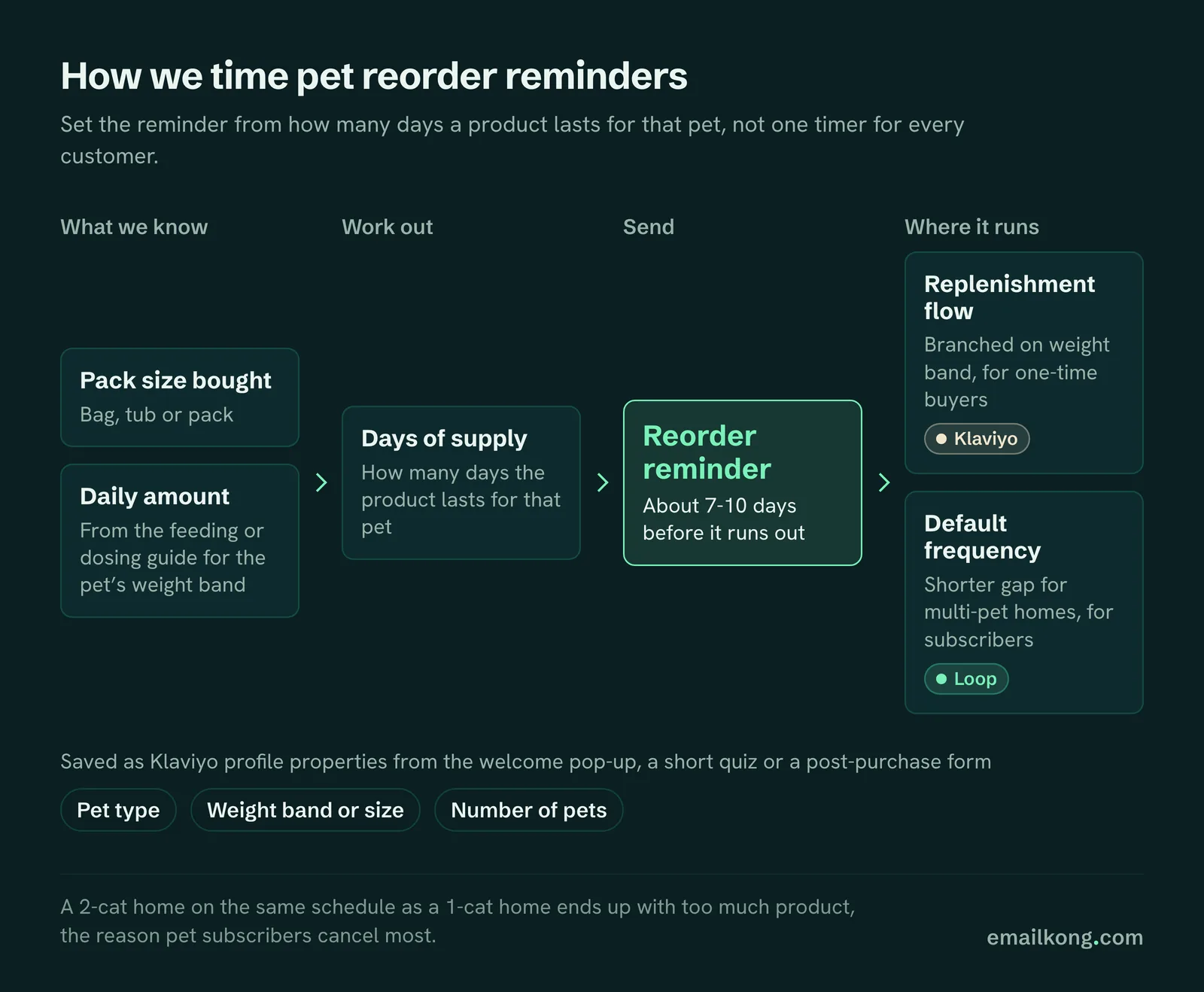
To do that in Klaviyo, the store needs to know 3 things about each customer: the pet type, the weight band or size, and how many pets are in the house. We collect them in the welcome pop-up, a short quiz or a post-purchase form, save them as profile properties and branch the replenishment flow on them.
This is the map we start from:
| Pet signal | What it changes | Where it lives |
|---|---|---|
| Pet type (cat, dog, both) | Which products and images each email shows | Klaviyo profile property from the pop-up or quiz |
| Weight band or size | Days of supply, so the reorder reminder date | Klaviyo property, used to branch the replenishment flow |
| Number of pets | Quantity per order and how often it ships | Klaviyo property, plus the default frequency offered in Loop |
| Pack size bought | When the reminder fires for one-time buyers | Shopify order data in Klaviyo |
| Life stage (puppy, kitten, senior) | Product suggestions and when to move to the next formula | Klaviyo property, updated with a date |
| Adoption day or birthday | A dated campaign or flow each year | Klaviyo date property |
For subscribers, the same logic sets the default frequency. If a 2-cat household is on the same schedule as a 1-cat household, one of them ends up with too much product, and that is the reason pet subscribers cancel most.
Multi-pet households
Ask how many pets a customer has, because it changes how much they buy and how often. A household with 3 dogs goes through food, treats and supplements much faster, and a starter pack sized for 1 pet runs out before the reorder email arrives.
What we change for multi-pet customers:
- Quantity at checkout. Show the bigger pack or a 2-pack first when the quiz says 2 or more pets.
- Subscription frequency. Offer a shorter gap between orders, and let them change it in the Loop portal without contacting support.
- Cross-sell. A household with a cat and a dog can buy from both ranges, so the post-purchase flow shows the other pet's products.
- Volume discounts. Loop's volume discounts reward the larger orders these households already need.
"My pet doesn't use it" and other pet cancel reasons
Pet brands get a cancel reason other niches never see: the product is fine, but the pet won't use it. Across the pet brands we run on Loop, "my pet doesn't use it" is 10-15% of cancel reasons. "Enough filters" is 18-23% and "too expensive" is about 16%.
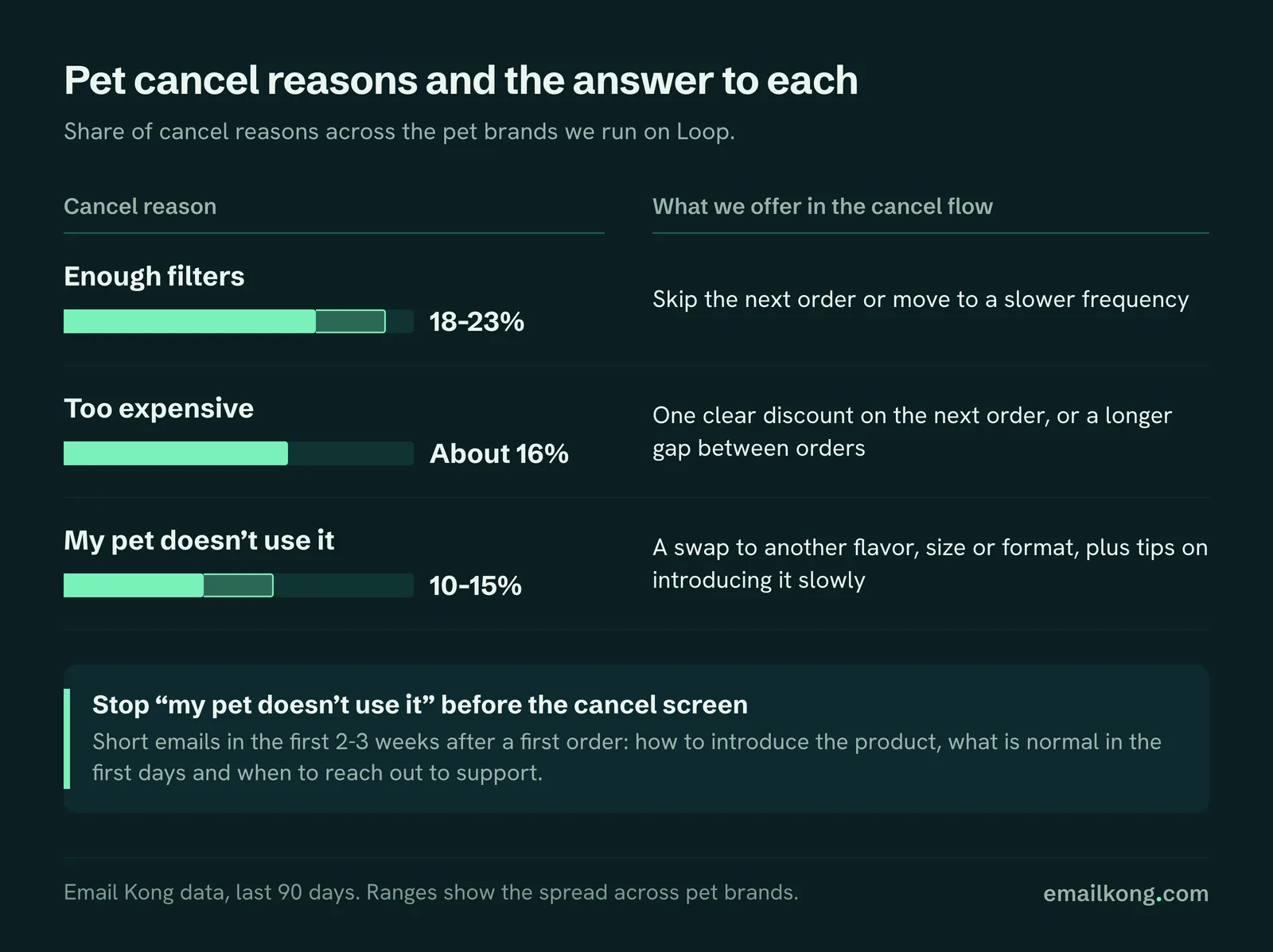
Each needs a different answer in the cancel flow:
- Enough product. Skip the next order or move to a slower frequency. This is the largest reason, and a discount does nothing for someone with a full cupboard.
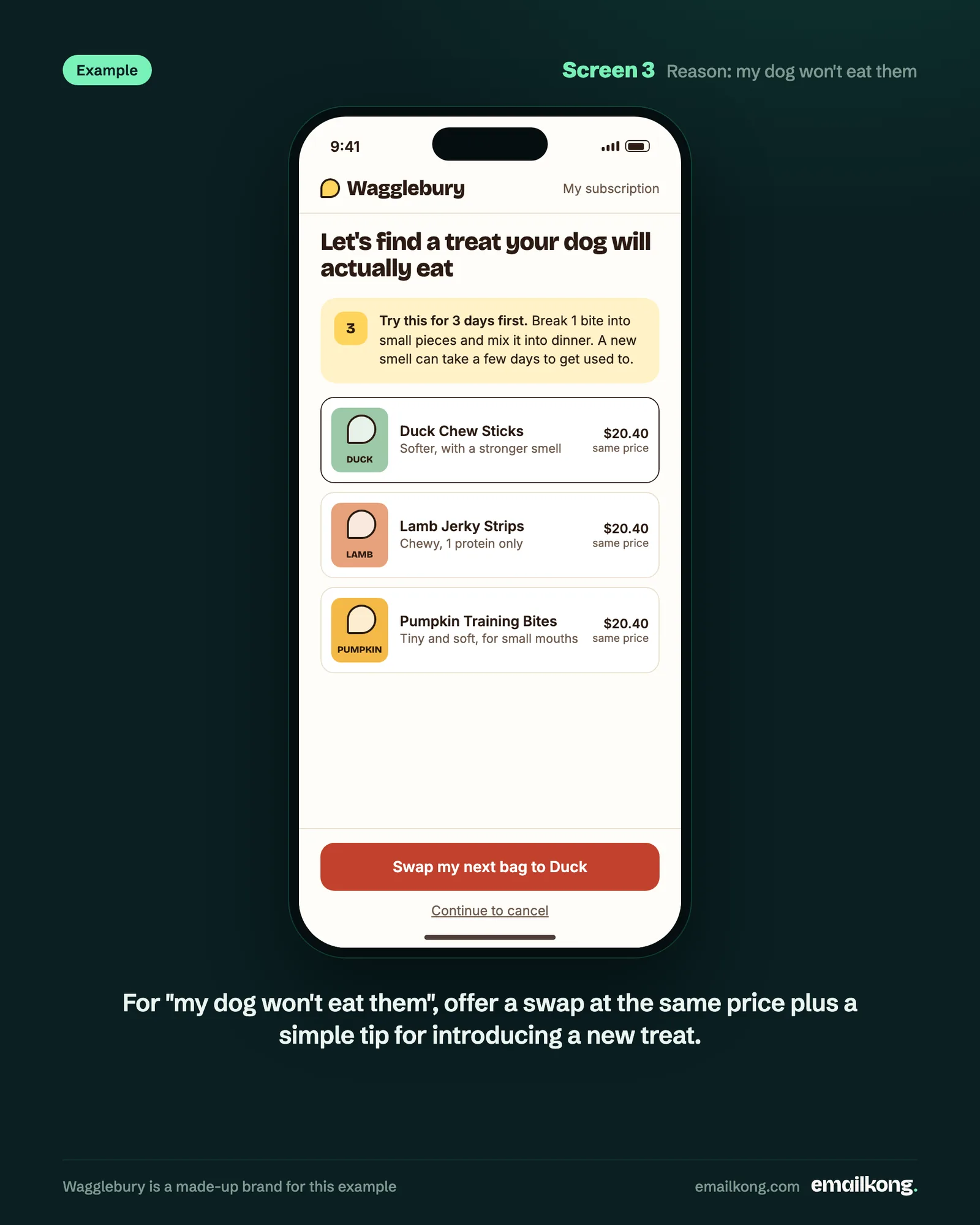
- My pet doesn't use it. Offer a swap to another flavor, size or format, and link to tips on introducing it slowly. Some of these customers only needed more time.
- Too expensive. One clear discount on the next order, or a longer gap between orders so the monthly cost drops.
The best time to stop "my pet doesn't use it" is before the cancel screen. In the first 2-3 weeks after a first order, we send short emails on how to introduce the product, what is normal in the first days and when to reach out to support. They also give owners an easy way to reach support before they reach the cancel screen.
Vet and health angles in pet emails
Health content earns trust with pet owners, as long as every claim comes from your label and product page. Joint, gut, skin and calming products sell on what they do for the pet.
The rules we follow on pet health copy:
- Use only claims your product page and packaging already make.
- When a vet works with the brand, name them and quote what they actually said.
- Write "ask your vet" where a pet's health is in question, especially for senior pets or pets on medication.
- Keep before-and-after language to what real reviews say, quoted as written.
Pet birthdays, adoption days and life stages
Pet owners celebrate their pets, so a birthday or adoption day is a natural reason to email. Collect the date once, save it in Klaviyo and trigger a short email each year with a small gift or a treat suggestion.
Life stage works the same way. A puppy or kitten moves to adult food, and an adult pet moves to senior formulas. A date property set at signup lets Klaviyo send the "time to switch" email when the change is due, which keeps the customer buying from you through the move.
EK proof
We run retention for 5 pet brands today, and 2 of them run their subscriptions on Loop with us.
- KittySpout (cat water fountains and filters): 46% of store revenue comes from Klaviyo. Read the case study.
- Across the subscription brands we run on Loop, "I have enough or too much product" is the #1 cancel reason, at about 23% of cancel attempts in the last 90 days (20,000+ cancel-flow events).
- About 1 in 5 people who start canceling give no reason at all, so we count saves per reason rather than as one overall rate.