
Why skincare retention is different
Skincare is bought as a routine, and each product in it runs out at a different time. A cleanser used morning and night, a serum used at night and an SPF used every morning empty at different rates, so one reorder email for the whole order lands at the wrong time for most of it.
Beauty is also a large subscription market with plenty of room to grow. Recharge's 2026 trend report counts about 9.4M active beauty subscribers. Eightx estimates subscriptions at 10-25% of revenue for beauty brands, well below pet or supplements, which leaves more one-time buyers to convert. Circana reported US mass beauty at $72.7B in 2025, up 5%, and prestige at $36B, up 4%.
Churn depends on the model. Eightx puts monthly churn for replenishment subscriptions at 5-8%, and for beauty boxes at 8-14%. A skincare brand that sells refills of products the customer already uses sits in the first group, as long as the timing fits their routine.
Routine-based replenishment
Time reorders per product, from the size on your product page and the amount your directions say to use, then send the reminder about 7-10 days before it runs out. When a customer owns 3 or 4 steps, we either send one email per product or group the steps that run out in the same week.
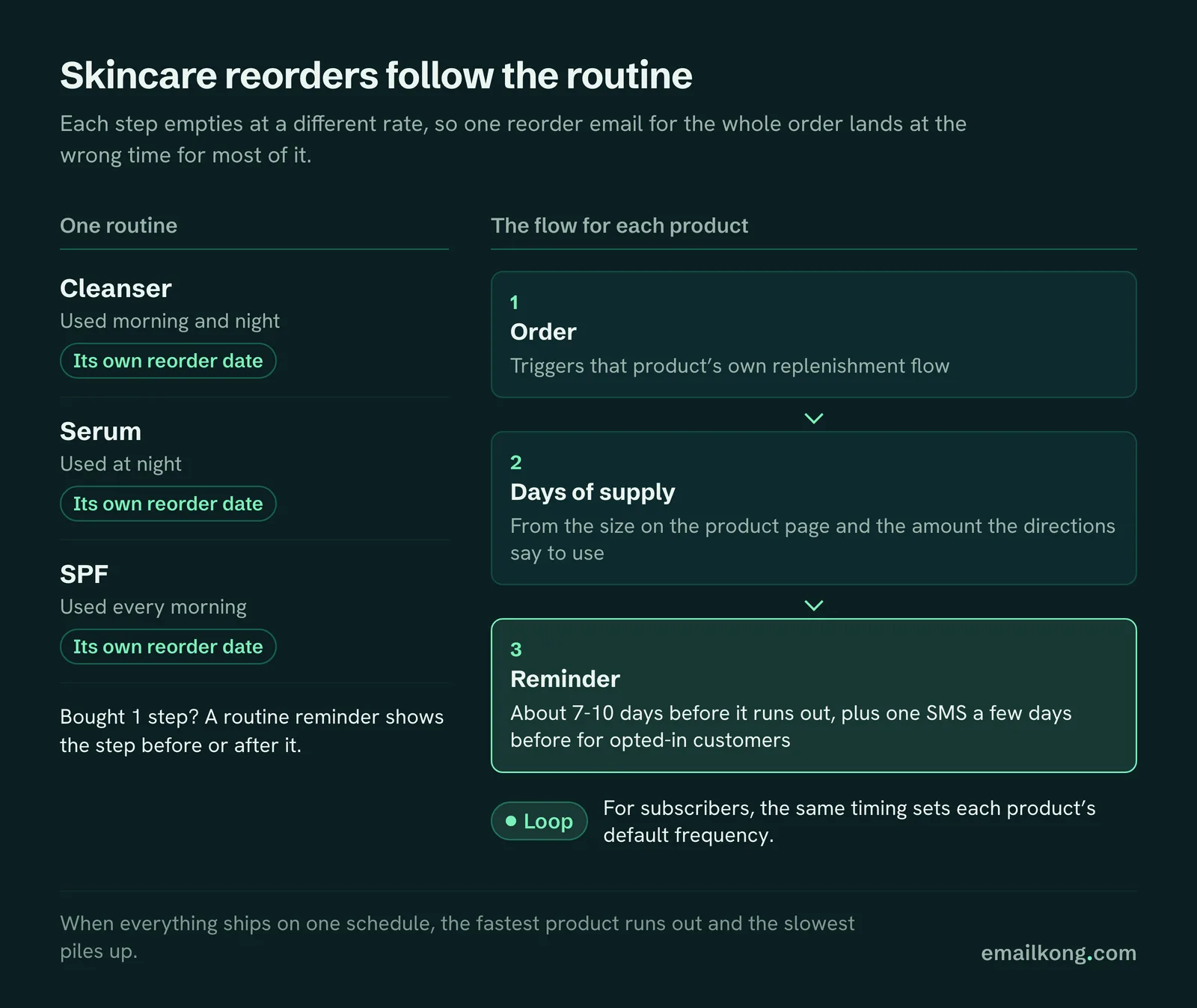
What that looks like in Klaviyo:
- One replenishment flow per product, triggered by the order and timed to that product's days of supply.
- A routine reminder for customers who bought 1 step, showing the step before or after it in the routine.
- One SMS a few days before a product runs out, for customers who opted in, kept short and linking straight to the product.
For subscribers in Loop, the same timing sets the default frequency per product. When everything ships on the same schedule, the fastest product runs out and the slowest piles up, and "too much product" becomes the reason they cancel.
Personalize by skin type, concern and shade
Ask for skin type and main concern once, save them in Klaviyo and use them in every email after. A customer with oily skin and one with dry skin need different product suggestions, and the welcome pop-up or a short skin quiz is where we collect it.
| Signal | How we collect it | What it changes |
|---|---|---|
| Skin type | Welcome pop-up or skin quiz | Which products each email suggests |
| Main concern | Skin quiz | Content in the onboarding series and campaign blocks |
| Shade (tinted SPF, concealer, base) | Order data or quiz | Product images and links, back-in-stock alerts for that shade |
| Routine steps owned | Shopify order history | Which missing step to suggest next |
| Sample or trial size bought | Order data | When the full-size email fires |
| Sensitivity or allergies | Quiz | Products left out of suggestions |
Shade matters most for tinted products. A customer who bought a specific shade should see that shade in every email, and a back-in-stock alert for it when it sells out.
Sampling to full size
Sample and trial buyers need one email timed to when the sample runs out, with a direct route to the full size. A trial size runs out much sooner than a full size, so a reminder timed like a full-size reorder reaches someone who has already stopped using it.
The flow we build for trial buyers:
- Day 0-2. How to use it and how long it lasts.
- Just before it runs out. The full size, with a credit for the sample price if the brand offers one.
- A week later. Reviews from customers who moved to full size, quoted as written.
If the sample came in a set, the email shows the full size of the product they used most, based on what they reorder or click.
Regimen bundles
A regimen bundle sells the full routine at once, which raises order value and gives the customer a reason to keep each step going. It works best when the bundle matches a concern the customer already told you about.
What we set up:
- Bundles by concern in the welcome and post-purchase flows, matched to the quiz answer.
- Add a step at renewal through Loop upsell profiles, so a subscriber can add a serum to their next cleanser order.
- Volume discounts in Loop for subscribers who keep 2 or more products on the same order.
Product claims in these emails stay inside what the product page says. A cosmetic that claims to treat a skin condition reads as a drug claim to the FDA, so lines like "clears acne" only appear when the product is sold as an over-the-counter treatment.
Skincare cancel reasons
Skincare subscribers cancel most for having too much product. In skincare on the brands we run on Loop, "too much product" is 20% of cancel reasons and "I just wanted the discount" is 10%.
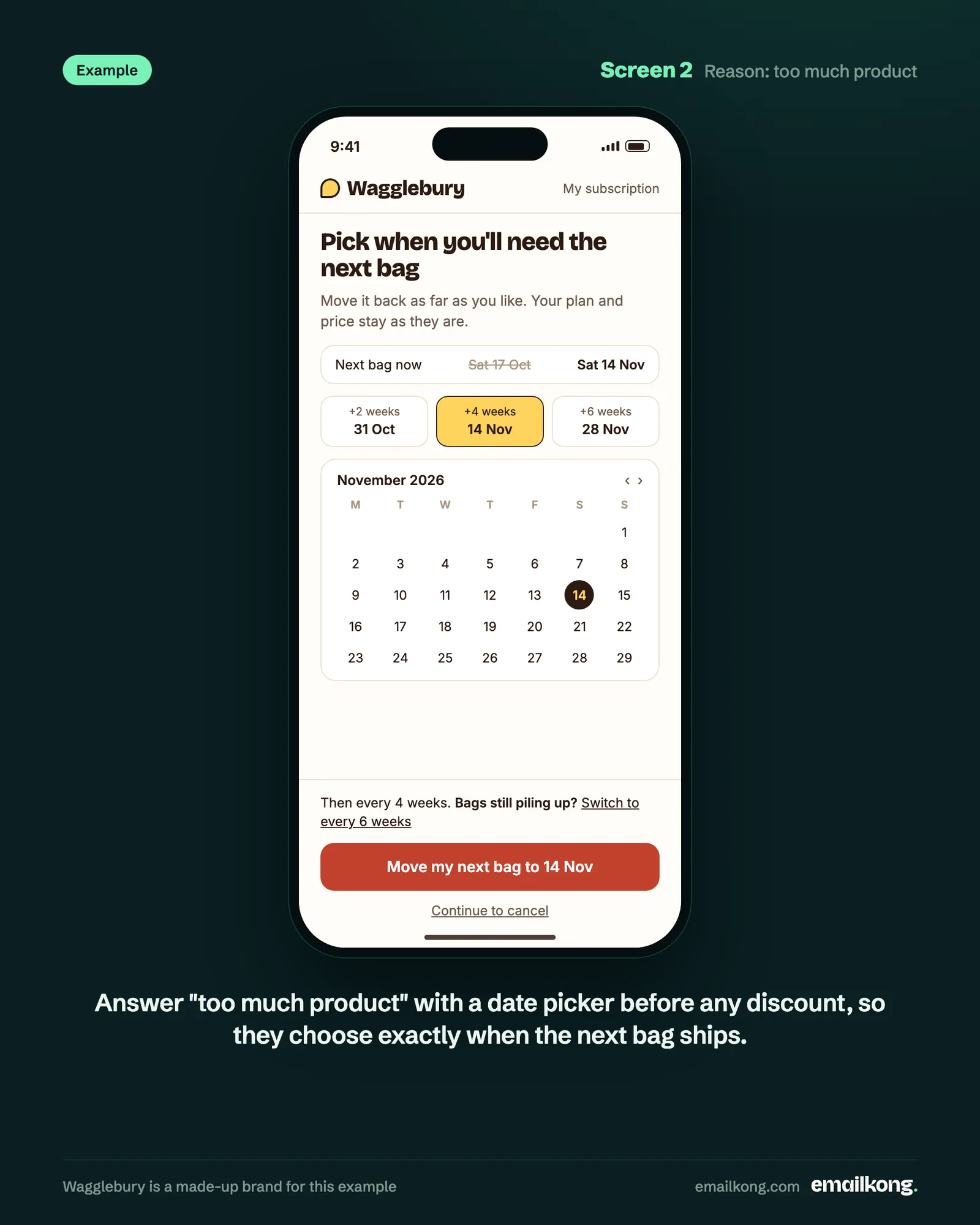
"I just wanted the discount" is about 10% of skincare cancel reasons, and it responds well to a skip or a pause. These subscribers joined for the first-order price, so a later order date often suits them better than a second discount.
The answers we start with:
- Too much product. Skip, or a slower frequency for the product that is piling up.
- I just wanted the discount. Skip or pause, with the new date shown.
- Too expensive. One clear discount, or a longer gap between orders.
- It didn't suit my skin. A swap to a product for their skin type, plus support.
EK proof
We run Klaviyo and Loop together for skincare and beauty brands.
- Penrose Skin (skincare): Klaviyo's share of store revenue went from 15.2% to 23.2%. Flow revenue grew 10.5x.
- Across the subscription brands we run on Loop, "I have enough or too much product" is the #1 cancel reason, at about 23% of cancel attempts in the last 90 days (20,000+ cancel-flow events).
- About 1 in 5 people who start canceling give no reason at all, so we count saves per reason.
.webp)