When SMS is worth adding
SMS is worth adding when email already covers the basics and you have moments where speed matters: a sale launch, a last-day reminder, an abandoned checkout or a failed subscription payment. It works on top of email. Brands that try to use it in place of email usually end up paying a lot to send discount codes.
Signs you are ready:
- Welcome, checkout abandonment and post-purchase flows are live and tested in email.
- Your signup form can ask for a phone number as a second step after the email.
- You run sales or launches where a reminder on the last day makes a difference.
- You have the budget to pay per message, which email does not require in the same way.
For subscription brands, SMS earns its place on payment recovery and on upcoming charge reminders, where a text is more likely to be read in time than an email.
Consent and compliance
You need clear, recorded consent before sending a marketing text, and the rules depend on where your customers live. Klaviyo provides consent tools and opt-in language, but the legal responsibility stays with the brand. This section is a practical summary, not legal advice.
United States
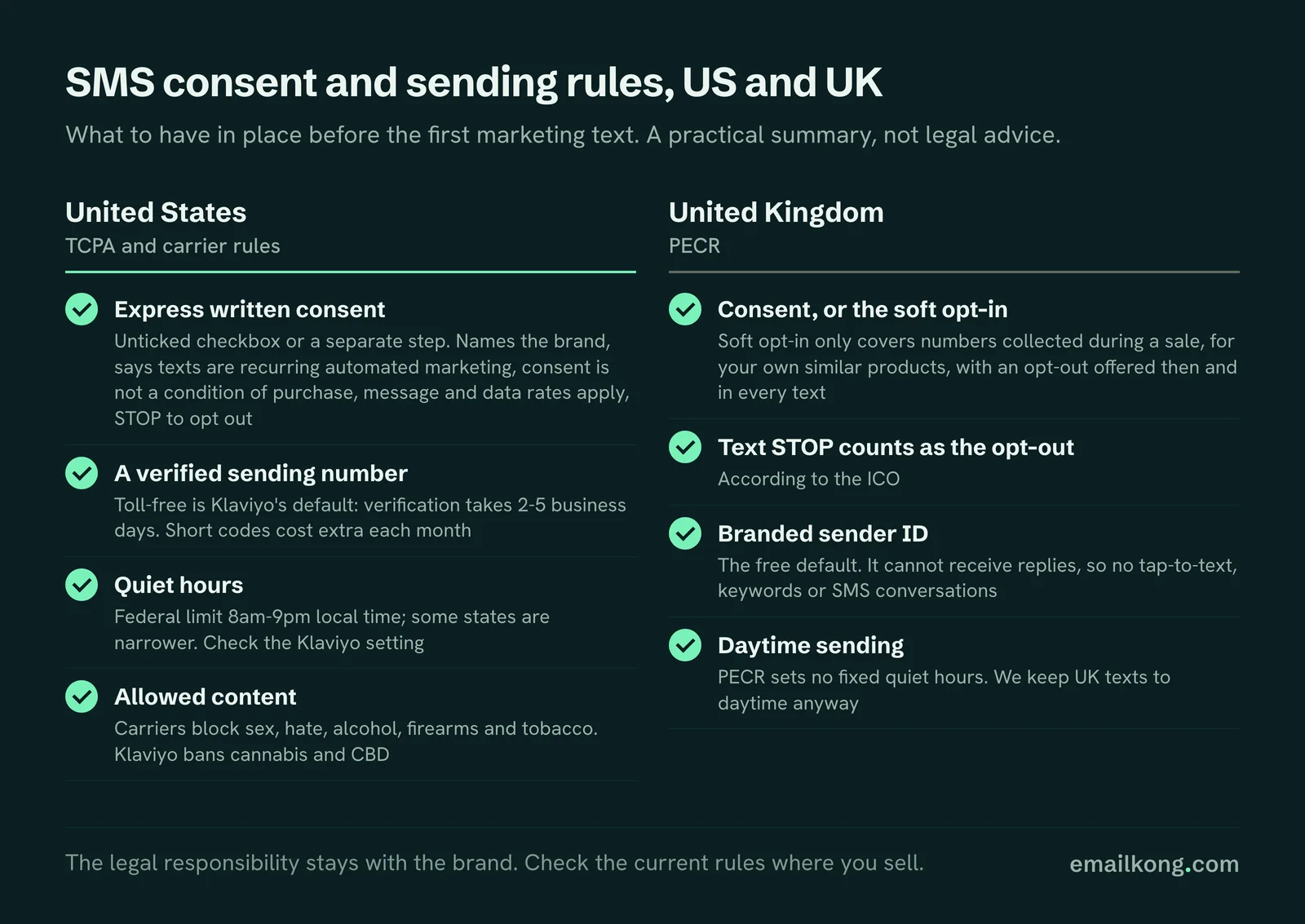
- Consent: marketing texts need the customer's express written consent under the TCPA. In practice that means an unticked checkbox or a separate form step with wording that names your brand, says the texts are recurring and automated marketing, says consent is not a condition of purchase, mentions message and data rates and explains how to opt out with STOP.
- Sending numbers: Klaviyo's default US sending number is a toll-free number, which must be verified before you send. Klaviyo's help center says verification takes 2-5 business days and that not every industry is eligible. Short codes are available at an extra monthly cost and take longer to approve. Klaviyo's help center lists toll-free and short codes for US sending, and does not list a US local long code.
- Quiet hours: federal rules limit telemarketing to 8am-9pm in the recipient's local time, and some states set narrower windows, so check the rules for the states you sell into. Klaviyo has a quiet hours setting under SMS sender preferences. Check it rather than assume the default, because Klaviyo's help articles describe different defaults for flows and campaigns.
- Restricted content: carriers block texts about sex, hate, alcohol, firearms and tobacco, and Klaviyo's acceptable use policy bans SMS about cannabis and CBD. A hemp ingredient in a skincare product can be enough to get a message refused.
United Kingdom
- Consent or soft opt-in: under PECR, marketing texts to individuals need consent, or the soft opt-in. The soft opt-in only covers people whose number you collected while selling to them, for your own similar products, with an opt-out offered when you collected it and in every text. A text-STOP instruction counts as that opt-out, according to the ICO.
- Sender: Klaviyo lists branded sender IDs (your brand name instead of a number) among its free sending options in some countries. In the UK a branded sender ID is the default and free, but Klaviyo says it cannot receive replies, so tap-to-text, keywords and SMS conversations are not available on it.
- Timing: PECR does not set fixed quiet hours. We still keep UK texts to daytime hours, because a text at 11pm costs more in unsubscribes than it earns.
Which flows to add SMS to
Add a text where it does something the email cannot, usually because of timing. In our flow structure a text sits a set gap after an email and repeats the email's offer rather than introducing a new one.
| Flow | Where the text goes | What it says |
|---|---|---|
| Welcome | 2 hours after the welcome email | The signup offer, in 1 line, with the link |
| Checkout abandonment | 2-3 hours after the second email | A reminder that the checkout is saved |
| Cart abandonment | Day 2 | A cart reminder |
| Winback (30 and 60 days) | 1 day after each winback email | The same credit or offer as the email |
| Post-purchase (after delivery) | Around day 12 | The next product to try |
| Replenishment | 5 days after the first reminder | A reorder link |
| Subscription payment failed | Alongside the card-update email | A link to update the card |
Browse abandonment does not get a text from us. Intent is too low to justify the cost or the interruption.
How often to send SMS campaigns
Text your most engaged subscribers for sale launches, final days and big product drops, and leave everyday content to email. We split SMS subscribers into 3 levels by how recently they clicked a text: people who clicked in the last 30 days get the routine texts, people who clicked 31-90 days ago get fewer, and quieter customers only get the biggest moments.
The number that tells you when you are sending too much is the unsubscribe rate per text. If a send loses 2-3% of recipients to unsubscribes, that group is getting too many. Texting the whole SMS list on every send is the fastest way to use up a budget and a list at the same time.
The rules we write every text to:
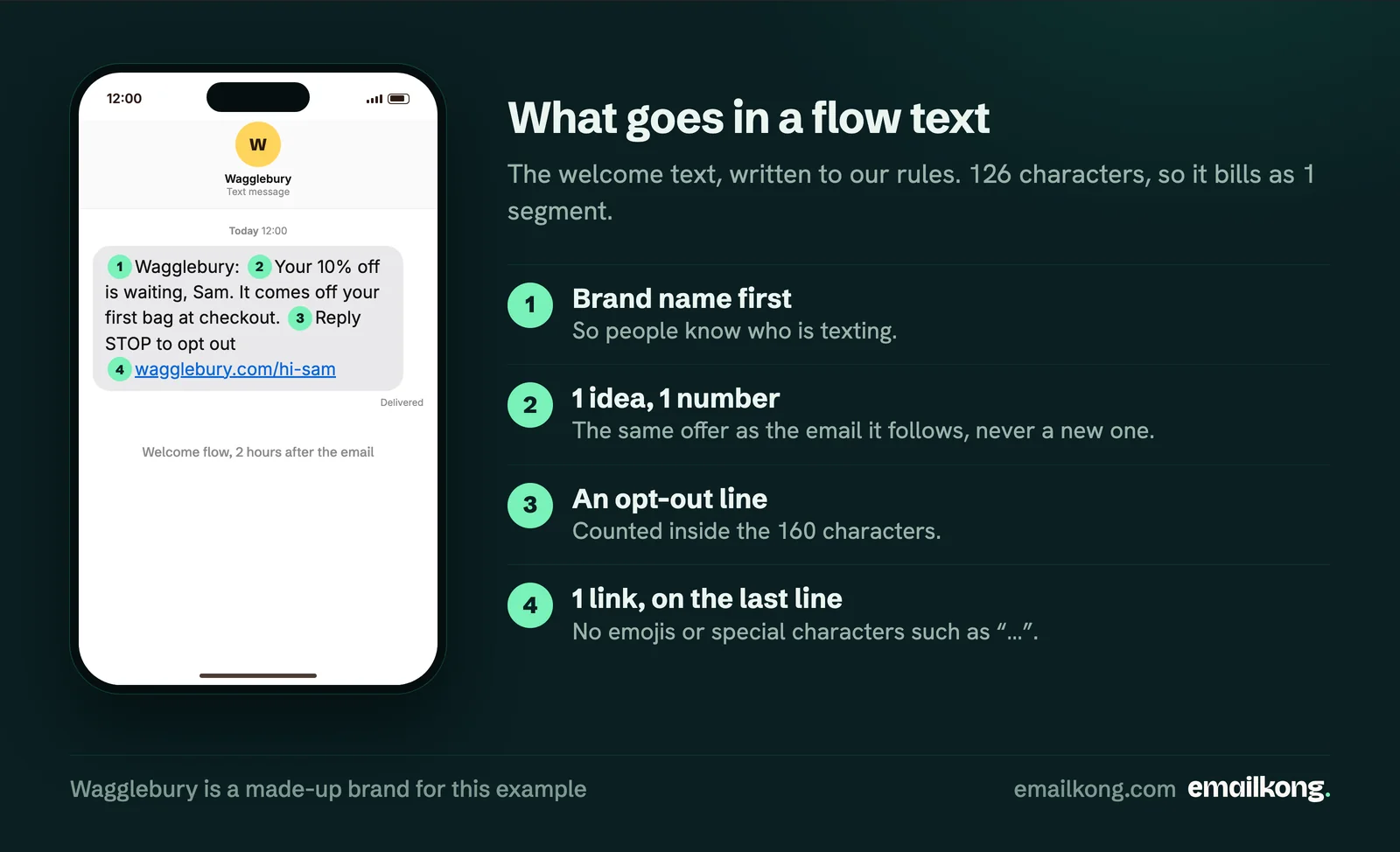
- Brand name at the start, so people know who is texting.
- 1 idea, 1 link, with the link on the last line.
- At most 1 number, and the same offer as the email it follows.
- No emojis and no special characters such as "…", and under 160 characters including the opt-out line.
What Klaviyo SMS costs
Klaviyo charges per message, and the price depends on the destination country, whether it is SMS or MMS and how many segments the message splits into. Klaviyo's help center (article last updated 29 September 2025, checked 11 October 2026) says accounts are moving from credits to a per-message price in dollars, with a monthly plan spend that does not roll over and carrier fees included in the rate. Your own rates are under Settings, Billing, Account Usage. Klaviyo's help center lists sending numbers as free except short codes, which carry a monthly cost; read the per-message rate for your country in your own account.
The legacy credit table on the same page shows how much the country matters:
| Destination | SMS (credits per segment) | MMS (credits per message) |
|---|---|---|
| United States | 1 | 3 |
| Canada | 3 | 5 (toll-free numbers only) |
| United Kingdom | 5 | Not listed |
| Australia | 4 | 15 |
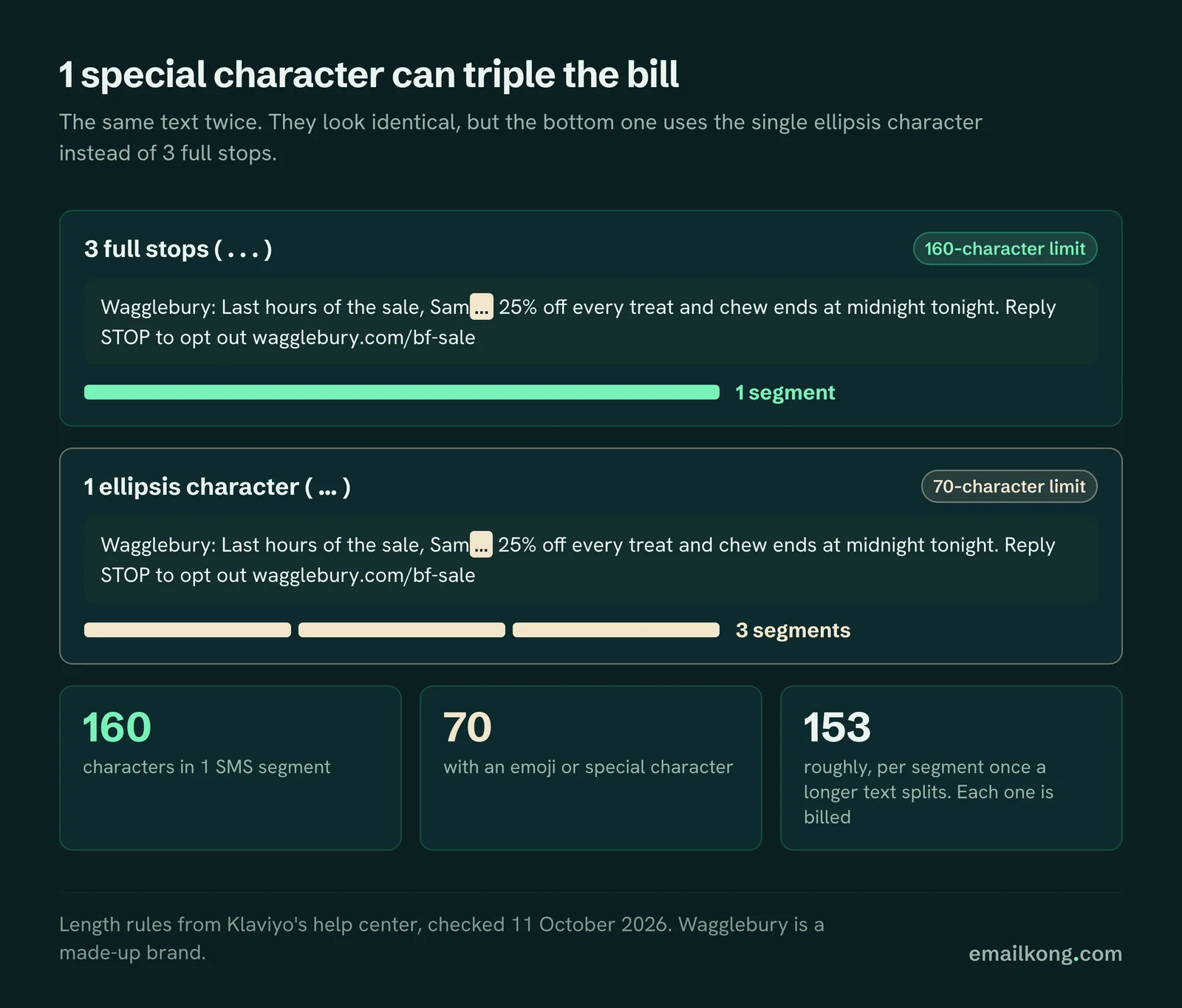
Length rules from the same article: an SMS segment holds 160 characters, or 70 if the text contains an emoji or special character. Longer messages split into segments of about 153 characters each, and each segment is billed. MMS allows up to 1,600 characters. Klaviyo's pricing page lists $5 of mobile messages a month on the free plan (checked 11 October 2026).
This matters more than most brands expect. On 1 account we found that a single "…" pushed a campaign text into the 70-character limit, so it billed as 3 segments per recipient, and that brand prefixes plus opt-out lines had turned the brand's other texts into 2 segments each.
EK proof
We run Klaviyo email and SMS together for DTC brands as a Klaviyo Master Platinum Partner, with 140+ brands and $59M+ in attributed Klaviyo revenue over 5 years. Every SMS brand we manage uses the same 3 engagement levels for texts, and we review credit or spend usage against the plan each month so Q4 sends do not run into overage charges.