The 3 options compared
Each option costs money in a different way and puts the risk in a different place. The figures below come from public market data, so use them to sense-check quotes and salaries rather than as fixed prices.
| Agency | In-house hire | Freelancer | |
|---|---|---|---|
| Typical cost | About $2,500-$10,000 a month retainer for Shopify brands | About $81,000 a year average base salary for a US email marketing manager with ecommerce skills, plus benefits, tools and often a designer | About $40-$150 an hour, or a fixed fee per project |
| Speed to start | Usually weeks: onboarding and an audit | Usually months: hiring, then ramp-up | Often days, for a defined project |
| Skills covered | Strategy, copy, design, flows, SMS, testing, often subscriptions | Usually 1-2 of these done well by one person | Usually 1 specialism, such as flows or design |
| Main risk | A junior team or a generic approach behind a senior pitch | One person leaves and the knowledge goes with them | Availability, and no one owns results after the project |
| Your management time | Low to medium: approvals and a regular call | High: hiring, briefing, reviews, career growth | Medium: briefing and checking each piece |
| Knowledge of your brand | Builds over months, shared across a team | Deepest, day to day | Limited to the project |
| Best for | $100,000+ a month brands that want a full programme | Larger brands with daily email work and a marketing lead | Early brands, or a team that needs a specific gap filled |
Sources: eCommerce Fastlane and InboxArmy for agency retainers, PayScale for US salary (based on a small sample, last updated February 2025), and Fiverr's 2026 guide for freelancer hourly rates. Fiverr is a freelancer marketplace, so treat its range as a guide only. Expert-level Klaviyo jobs posted on Upwork in October 2026 listed client budgets of roughly $25-$60 an hour, so quotes vary widely.
What each option really costs
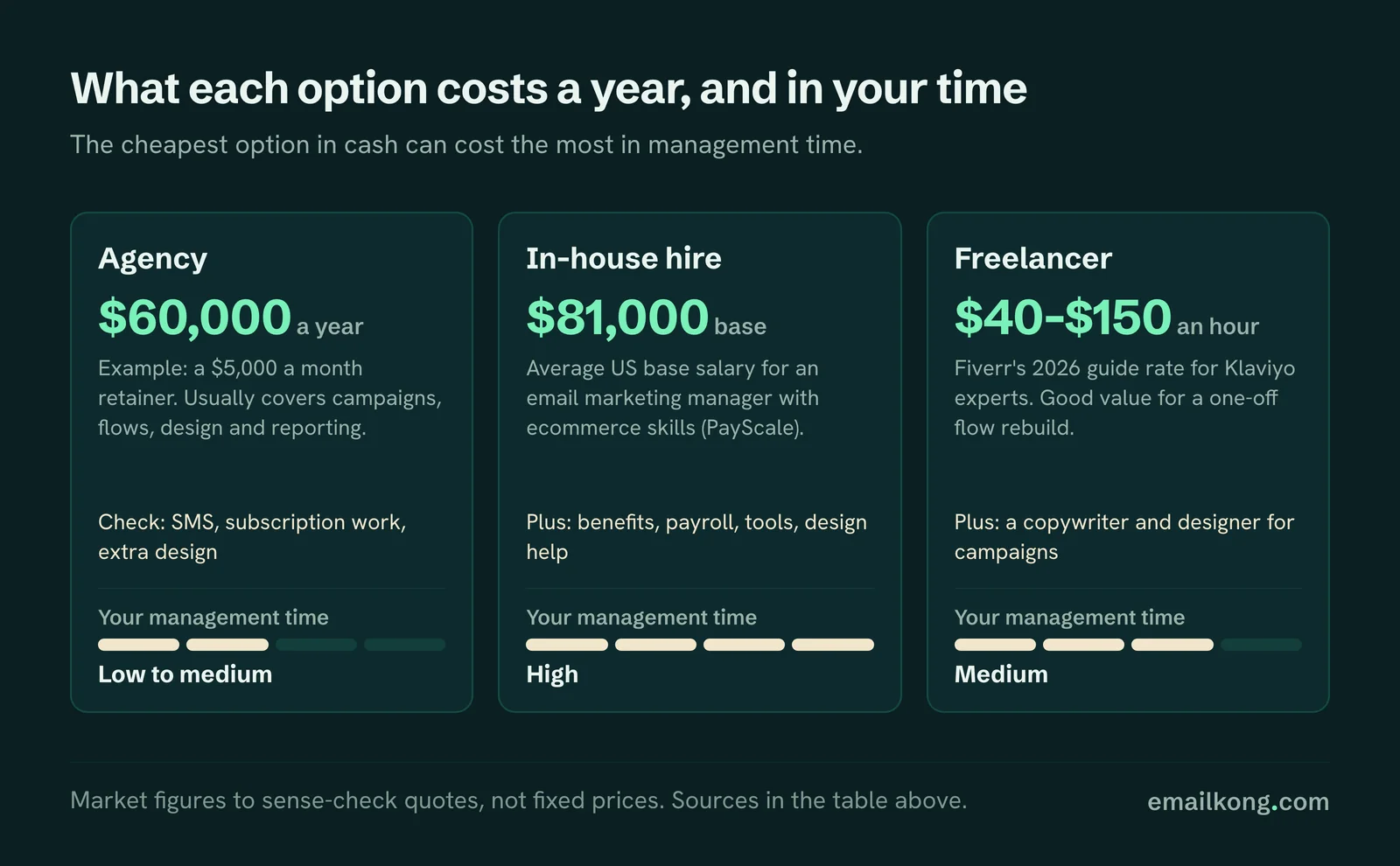
Compare the yearly cost of each option against the work you need done each month. A salary looks cheaper than a retainer until you add what one person cannot do alone.
- Agency. A $5,000 a month retainer is $60,000 a year. It usually covers campaigns, flow work, design and reporting. Check whether SMS, subscription work and extra design are included.
- In-house. PayScale puts the average base salary for a US email marketing manager with ecommerce skills at about $81,000, with most between $46,000 and $115,000. Add benefits, payroll costs, training and tools. Most in-house email marketers also need design help, from a designer on staff, a freelancer or a design subscription.
- Freelancer. Fiverr's 2026 guide puts Klaviyo experts at about $40-$150 an hour. A flow rebuild might take a few days of work, so a freelancer is good value for a one-off job. Ongoing campaign work billed by the hour adds up quickly.
A worked example. Take a hypothetical brand doing $200,000 a month that needs 16 campaigns a month, a flow rebuild and SMS:
- Agency: one retainer, for example $5,000 a month, or $60,000 a year, with the flow rebuild sometimes quoted separately.
- In-house: an $81,000 salary plus benefits and tools, and design help for 16 emails a month, before anyone covers holidays.
- Freelancers: a flow builder for the rebuild at $40-$150 an hour, plus a copywriter and a designer for the monthly campaigns, with you or a team member planning the calendar and checking the work.
The freelancer route can be cheapest in cash. It costs the most in your own time, because someone in the business has to plan the work and join it up. The cheapest option on paper can also cost more in lost revenue if campaigns slip or flows go months without anyone checking them.
Speed and skill coverage
An agency or a freelancer can start within weeks. An in-house hire takes longest to start but knows the brand best once settled.
Email for a growing DTC brand needs several skills at once: strategy and calendar planning, copywriting, design, flow building, segmentation, deliverability, SMS, testing and reporting. Subscription brands add the cancel flow, payment recovery and winback inside apps like Loop. It is rare to find one person who is strong at all of them.
- An agency spreads these across a team. You get the range, but you need to check who is senior and how much time your account gets.
- An in-house marketer usually covers strategy and sending well, and leans on others for design and technical work.
- A freelancer is usually strong in one area. Many brands use a freelance designer or flow builder alongside an in-house marketer.
Risk and management time
Each option puts the risk in a different place. With an agency, the risk is a generic approach. With a hire, it is losing one person. With a freelancer, it is availability and ownership.
- Key-person risk. If your only email marketer leaves, campaigns stop until you rehire. An agency covers holidays and departures inside its team.
- Quality risk. An agency can sell with senior people and staff your account with juniors. Ask who will work on it each week, by name.
- Ownership risk. Whoever you choose, keep the Klaviyo account in your name and give them user access, so flows and data stay with you.
- Management time. An in-house hire needs the most: hiring, briefing, reviewing and developing them. An agency needs approvals and a regular call. A freelancer needs a clear brief for each piece of work.
When each option wins
The right choice depends mostly on your revenue, how much email work you have and whether someone in the business can manage it.
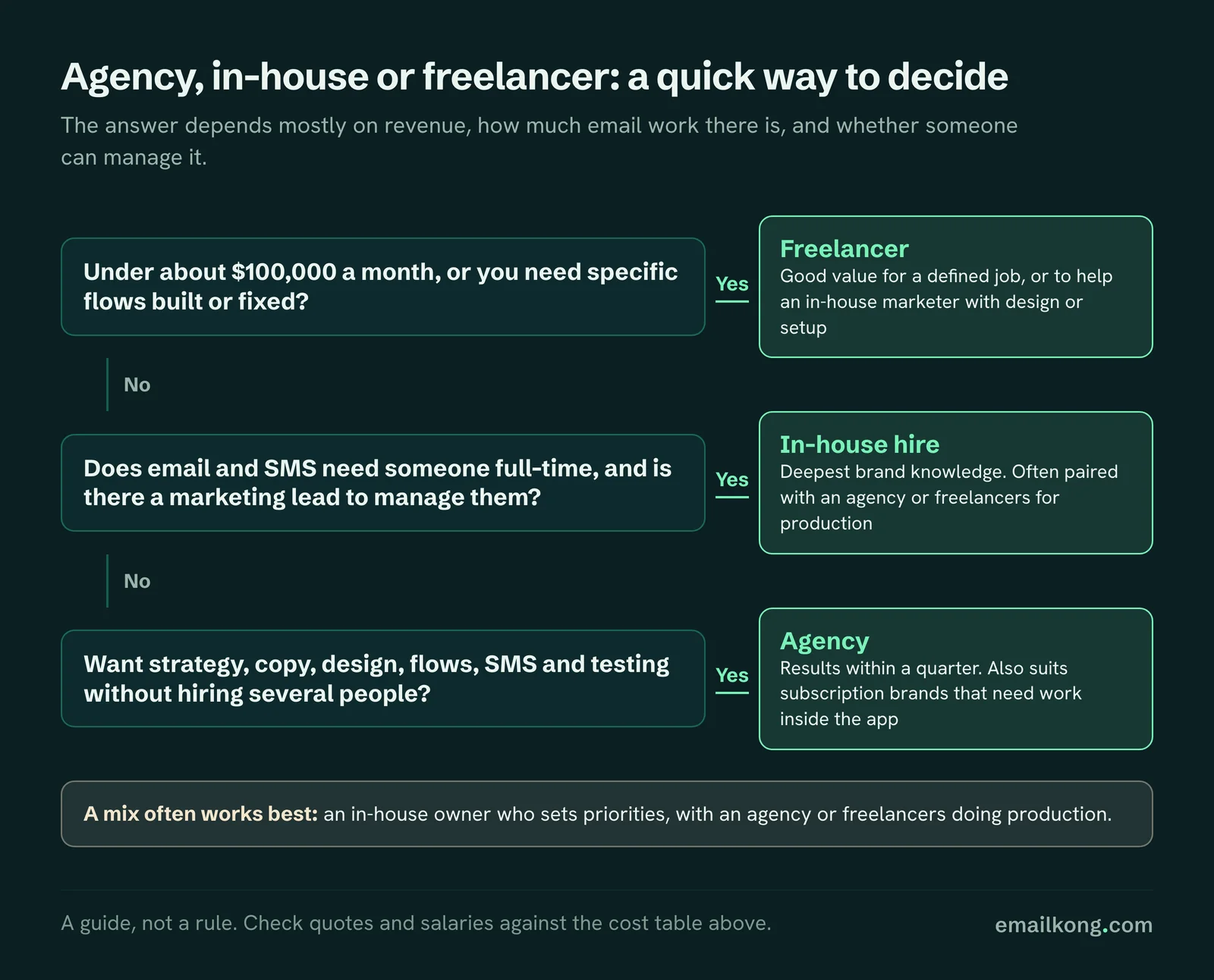
A freelancer wins when you are under about $100,000 a month, need specific flows built or fixed, or already have someone in-house who needs help with design or technical setup.
An in-house hire wins when email and SMS need someone full-time, you have a marketing lead who can manage them, and you want deep brand knowledge in the building. Larger brands often combine an in-house lead with an agency or freelancers for production.
An agency wins when you are above about $100,000 a month, want strategy, copy, design, flows, SMS and testing without hiring several people, and want results within a quarter. It also suits subscription brands that need someone working inside the subscription app as well as Klaviyo.
A mix often works best. An in-house owner who sets priorities, with an agency or freelancers doing production, gives you brand knowledge and capacity at the same time.
If you decide on an agency, use our guide on how to choose a Klaviyo agency for the questions to ask before you sign.
EK proof
Email Kong is a Klaviyo Master Platinum Partner and an official Loop partner. We have worked with 140+ DTC brands over 5 years, with $59M+ in revenue attributed to Klaviyo. Each account has its own flows and campaign managers, with design and copy handled by our team. Results we can share, measured as Klaviyo's share of total store revenue:
- Kaori (women's health, subscription): Klaviyo went from 3.3% to 19% of store revenue. Flow revenue grew 17.7x.
- Penrose Skin (skincare, subscription): Klaviyo's share went from 15.2% to 23.2%.
- TwoPackBag (travel bags, one-time purchase): Klaviyo's share went from 17.3% to 23.7%.
- KittySpout (pet, subscription): 46% of store revenue comes from Klaviyo.