When a Klaviyo agency makes sense
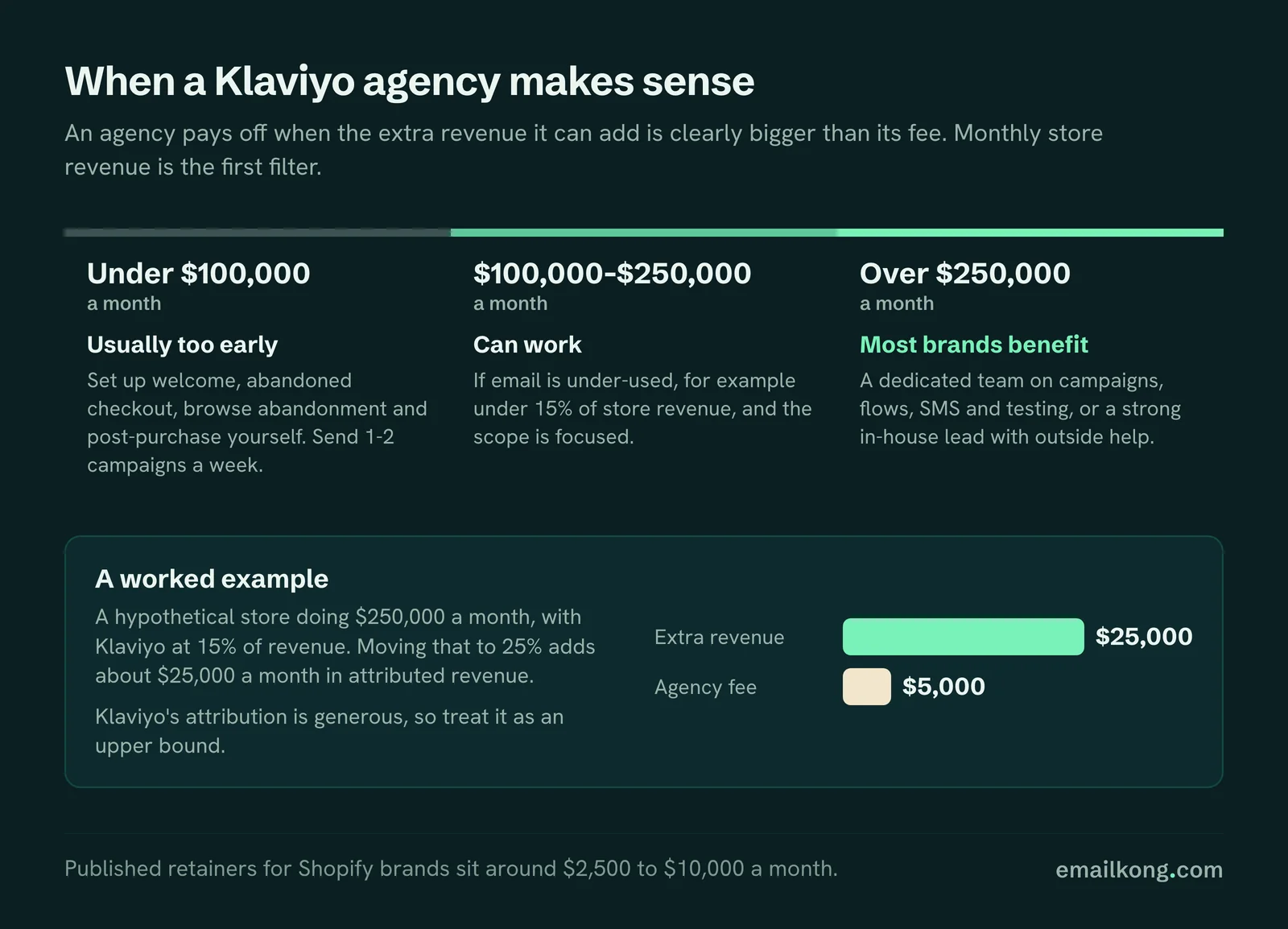
An agency pays off when the extra revenue it can add is clearly bigger than its fee. Published retainers for Shopify brands sit around $2,500 to $10,000 a month, so the store needs enough customers and traffic for better email to move real money.
A rough way to check: take your monthly store revenue, assume email could grow by 5-10% of that over a year, and compare the result with the fee.
- Under about $100,000 a month: usually too early for a full retainer. Set up the core flows yourself (welcome, abandoned checkout, browse abandonment, post-purchase), send 1-2 campaigns a week and revisit later.
- $100,000 to $250,000 a month: an agency can work if email is under-used, for example under 15% of store revenue, and the scope is focused.
- Above $250,000 a month: most brands at this size benefit from a dedicated team on campaigns, flows, SMS and testing, or a strong in-house lead with outside help.
Take a hypothetical store doing $250,000 a month where Klaviyo is 15% of revenue. Moving that to 25% is about $25,000 more attributed revenue a month, against a fee of $5,000. Klaviyo's attribution is generous, so treat that as an upper bound and watch total store revenue too.
If you are weighing other options, read our comparison of an agency, in-house hire and freelancer.
What to look for in a Klaviyo agency
The best sign is an agency that can explain exactly what it would change in your account, and who would do it. Logos and badges help, but they do not tell you how your account will be run.
Look for:
- A named team. Who writes the copy, who designs, who builds flows, and who is your day-to-day contact.
- Proof measured at store level. Klaviyo revenue as a share of total store revenue, before and after, with dates. This is harder to inflate than "email revenue grew 300%".
- Experience in your type of business. A subscription supplement brand, a jewelry brand and a furniture brand need different flows, offers and timing.
- A testing habit. Ask how many A/B tests they are running right now and what they learned from the last one.
- Depth beyond email. If you run subscriptions, can they work inside your subscription app on the cancel flow and payment recovery, or only send emails about it?
- A clear first 90 days. What gets fixed first, by when, and how you will know it worked.
12 questions to ask any agency before signing
Ask every agency the same questions in writing, so you can compare answers side by side. The table shows what a good answer and a worrying answer sound like.
| Question | A good answer | A worrying answer |
|---|---|---|
| Who will work on my account each week? | Names and roles: strategist, copywriter, designer, flow builder | "Our team", with no names |
| How many brands does my account manager handle? | A specific number they are happy to share | Avoids the question |
| How do you measure results? | Klaviyo revenue as a share of store revenue, checked against Shopify | Only Klaviyo-attributed revenue and open rates |
| What would you change first in my account? | Specific findings after looking at your account | A generic plan that could fit any brand |
| How many campaigns and flows are in the scope? | A number per month, plus which flows they will build or rebuild | "Unlimited emails" |
| How much is designed and how much is plain text? | A split that fits your brand and their design capacity | No idea, or everything designed with no turnaround time |
| How do you protect deliverability? | Engagement tiers, sunset flow, spam complaint monitoring | Sending to the full list every time |
| Who owns the Klaviyo account and flows? | You do; the agency works as a user on your account | They build in their own account or templates you lose when you leave |
| What is the minimum term and notice period? | Clear terms in the contract before you sign | Long lock-in with no performance review point |
| How do you price: retainer, % of revenue or both? | A written scope with a fixed fee, or a % deal with attribution rules defined | A % of all Klaviyo revenue with no window or baseline |
| Can I see 2-3 results from brands like mine? | Named or anonymised brands, with dates and how they measured | Only round numbers with no time frame |
| What happens on a busy week like Black Friday? | A plan for dates, offers, approvals and who is on call | "We'll figure it out closer to the time" |
Red flags to watch for
The biggest red flag is a promise made before the agency has looked at your account. Good agencies need to see your data before they commit to anything.
- Guaranteed numbers on the sales call, such as "we'll add 30% to your revenue", before an audit.
- % of revenue deals on all Klaviyo revenue, including flows that were already running before they arrived.
- Results shown only in open rates. Apple Mail Privacy Protection inflates opens, so they say little about revenue.
- No access to your own account, or flows built in a way you cannot keep.
- One person doing strategy, copy, design and sending for many brands at once, with no backup.
- A sales team you never hear from again once the contract is signed.
- Heavy discounting as the main lever. It lifts revenue in the short term and trains customers to wait for codes.
How to compare proposals like for like
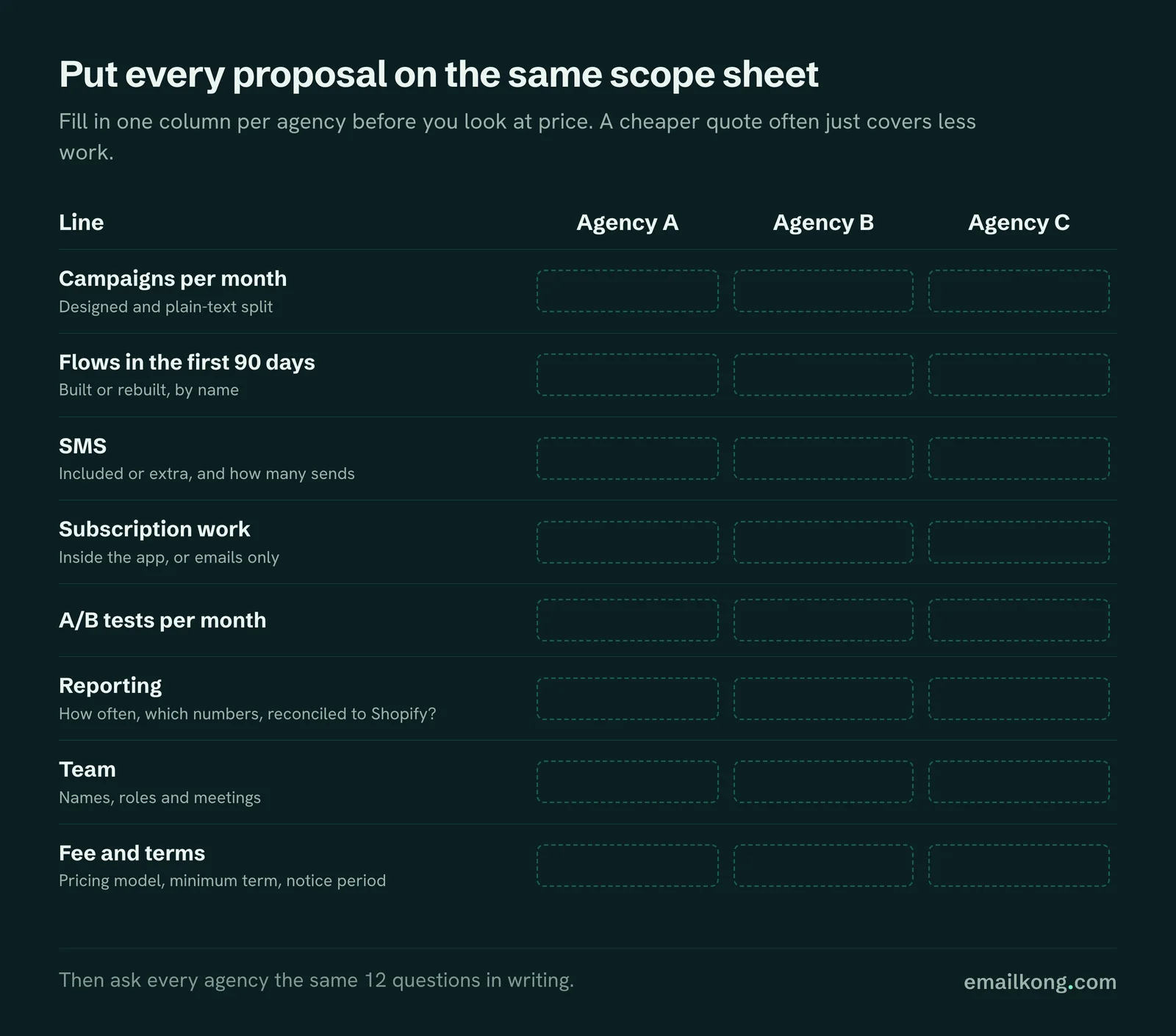
Put every proposal into the same scope sheet before you look at price. Agencies describe their packages differently, so a cheaper quote often just covers less work.
Use these lines for each agency:
- Campaigns per month, and the designed and plain-text split.
- Flows to build or rebuild in the first 90 days, by name.
- SMS: included or extra, and how many sends.
- Subscription work: cancel flow, payment recovery and winback inside the app, or emails only.
- A/B tests per month.
- Reporting: how often, which numbers, and whether they reconcile to Shopify.
- Team: names, roles and meetings.
- Fee, pricing model, minimum term and notice period.
For market price ranges and how retainer and % of revenue deals work, see our Klaviyo agency pricing guide.
What Klaviyo partner tiers tell you
A Klaviyo partner tier tells you an agency has met Klaviyo's thresholds for certified staff and the revenue it manages or refers. It does not tell you who will work on your account or how good their copy is.
Klaviyo's partner programme has 2 tracks: Advisor, for partners who refer brands, and Master, for partners who run Klaviyo for their clients. Each track has tiers from Bronze up to Elite (Bronze, Silver, Gold, Platinum, Elite), with higher requirements at each step, according to Klaviyo Academy's partner program training, checked 11 October 2026. A high tier is a reasonable filter for a shortlist. Use the questions above to decide between the agencies on it.
Start with an audit or a scoped first 90 days
The safest way to test an agency is a small, defined piece of work before a long contract. An audit of your Klaviyo account, or a first 90 days with named deliverables, shows you how the agency thinks and works.
A useful audit names specific problems in your account, puts a rough value on each one and tells you what to fix first. If it reads like a list of best practices that could apply to any brand, the agency has not really looked.
EK proof
Email Kong is a Klaviyo Master Platinum Partner, ranked in the top 2.5% worldwide, and an official Loop partner. We have worked with 140+ DTC brands over 5 years, with $59M+ in revenue attributed to Klaviyo and a 65.2x average ROI. Our Trustpilot rating is 4.5. Results we can share, measured as Klaviyo's share of total store revenue:
- Kaori (women's health, subscription): Klaviyo went from 3.3% to 19% of store revenue. Flow revenue grew 17.7x.
- Penrose Skin (skincare, subscription): Klaviyo's share went from 15.2% to 23.2%. Flow revenue grew 10.5x.
- TwoPackBag (travel bags, one-time purchase): $1.38M in flow revenue in 90 days. Klaviyo's share went from 17.3% to 23.7%.
- KittySpout (pet, subscription): 46% of store revenue comes from Klaviyo.