Disclosure: Email Kong is an official Loop partner, and our hands-on subscription work is inside Loop. For Recharge, this page relies on published documentation, and staying on Recharge is the right answer for some brands.
Should you move at all?
Move if your subscription app is holding back retention or costing more than it should for your volume. Stay if Recharge works for you and your cancel flow and payment recovery are performing.
Recharge says it serves about 20,000 brands, and in April 2026 it agreed to buy Skio. Plenty of brands run well on it. Common reasons brands look at Loop:
- Fees at their order volume.
- Wanting more control over the cancel flow, retention offers and payment recovery strategies.
- Wanting the subscription portal and Klaviyo program run by the same team.
Before you decide, get your Recharge contract terms, notice period and export options in writing, and ask Loop for a timeline and price based on your store. Loop's Recharge page says migration is included on every paid plan with no setup or migration fees (checked 11 October 2026).
What moves and what you rebuild
Loop exports your subscriptions through the Recharge API, converts them to its format, imports them at a scheduled time and then cancels the Recharge subscriptions in bulk so nobody is charged twice. Settings, designs and anything built in Klaviyo do not move and need rebuilding.
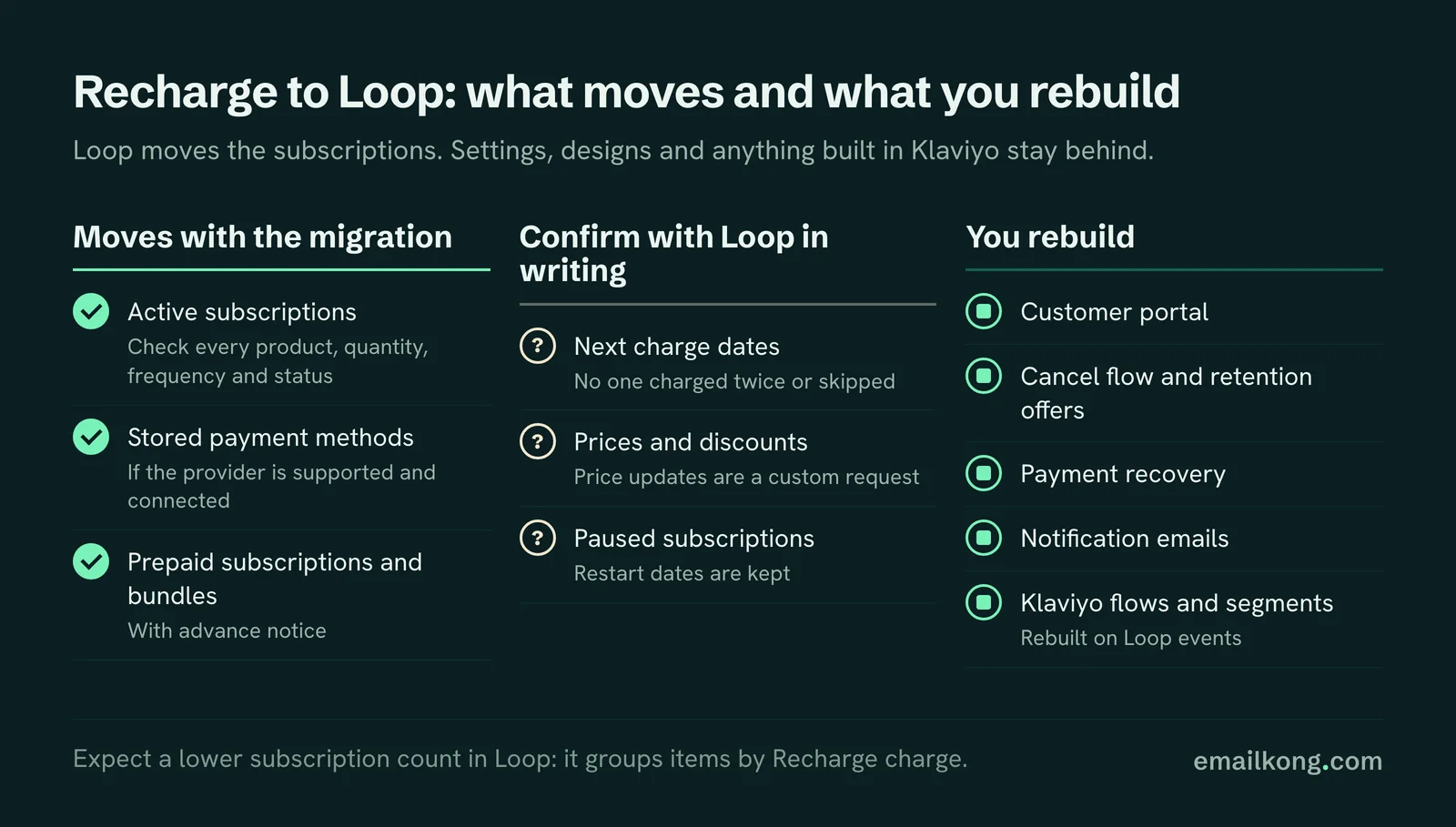
| Area | Moves with the migration? | What to check |
|---|---|---|
| Active subscriptions | Yes | Every product, quantity, frequency and status matches |
| Next charge dates | Confirm with Loop | No subscriber is charged twice or skipped around cutover |
| Stored payment methods | Yes, if the provider is supported and connected | Subscribers on an unsupported provider who will need to update their card |
| Subscription prices and discounts | Confirm with Loop; price updates are a custom request | Legacy prices from early subscribers survive; raise price changes at least a week ahead |
| Prepaid subscriptions and bundles | With advance notice | Remaining order counts and bundle contents are right |
| Paused subscriptions | Confirm with Loop | Restart dates are kept |
| Customer portal | No, built in Loop | Skip, swap, pause and frequency changes are easy to find |
| Cancel flow and retention offers | No, built in Loop | Your best offers are rebuilt, not replaced with defaults |
| Payment recovery | No, set up in Loop | Retry schedule and card-update messages are live from day 1 |
| Notification emails | No, set up in Loop | Branded, and not duplicated by Klaviyo |
| Klaviyo flows and segments | No, rebuilt on Loop events | See the section below |
Ask Loop to confirm in writing which fields come across for your store, including next charge dates, prices, discounts and paused status. Expect Loop's subscription count to be lower than Recharge's. Loop's help center explains that it groups products by Recharge charge, so 1 Loop subscription can hold several items that Recharge counted as separate subscriptions.
Payment methods and gateways
Subscribers keep their saved cards when Loop can access the payment provider Recharge used. Loop's guide for Recharge stores on the legacy checkout (last updated 6 November 2025) lists Stripe, Authorize.net, Braintree and PayPal, and requires 3 things from you:
- The payment provider connected to Shopify as a secondary provider, unless it is already your primary.
- An API token from that provider, so Loop can fetch the tokenized payment methods.
- A Recharge API key with full write access.
You can see which processor you use in Shopify under Apps, Recharge, Settings, Payment. PayPal needs recurring billing enabled. If some subscribers sit on a provider Loop cannot reach, plan a card-update email and text for them before cutover.
Recharge also runs on Shopify's own checkout for many stores, and the steps differ there. Loop's help center says your payment provider must be added to Shopify as a secondary provider so Loop can bill with the same stored payment methods, and Loop cancels the Recharge subscriptions after import so no one is charged twice. Confirm your setup with Loop before you set a date.
Selling plans, prices and the portal
Rebuild every subscription frequency and discount in Loop so each subscriber keeps the price they signed up at. Loop asks for custom requirements such as price updates, variant swaps, bundle migration and prepaid subscriptions at least a week before the migration date.
The portal is where most saves happen, so build it before cutover rather than after. Make skip, swap, pause and change frequency easy to find, brand it and set up the cancel flow with reasons written in your customers' words. Our cancel flow guide covers which offer to show for each reason. Update every link to the old Recharge portal, including those on the site, in Klaviyo templates and in SMS.
Timeline
Loop says a migration typically takes about 2 weeks, whichever app a brand is moving from, and that timing depends on subscriber volume, discount complexity and custom integrations. It also cites a brand that moved about 130,000 subscribers in 22 days. These are Loop's own figures.
From our side, plan the weeks before the data move for the portal, cancel flow, payment recovery and Klaviyo rebuild, and the 30 days after it for checking renewals and comparing results. Pick a cutover date away from your biggest billing days and away from Black Friday week.
The Klaviyo events and flows to rebuild
Every Klaviyo flow, segment and template that depends on Recharge data stops working once Recharge stops sending events. This is the part most migrations underestimate.
Before the move, list everything in Klaviyo that uses Recharge:
- Flows triggered by Recharge metrics, such as "Subscription started on ReCharge" and the metrics for upcoming charges, failed charges and cancellations. Check your metric list for the exact names in your account.
- Segments and flow filters that use Recharge profile properties, which start with rc_, such as an "active subscriber" flag. If this segment breaks, subscribers start getting one-time reorder reminders and first-order offers.
- Links to the Recharge portal in templates, flows and SMS.
- Campaign exclusions that rely on Recharge data.
Then rebuild each one on Loop's events, for example "Loop Subscription Cancelled", "Loop Billing Attempt Failed and will be Retried", "Loop Order Processed" and "Loop Payment Method Expiring". Keep the new flows in draft until Loop events arrive with real volume, switch them live, then turn off the Recharge versions and keep those as drafts for comparison. Our failed payment guide covers the recovery side.
Risks and a safe order for the move
The main risks are double charges, missed renewals, subscribers who need a new card, broken subscriber segments in Klaviyo and a cancel flow that falls back to defaults. Running both setups side by side for a short period and testing before cutover avoids most of them.
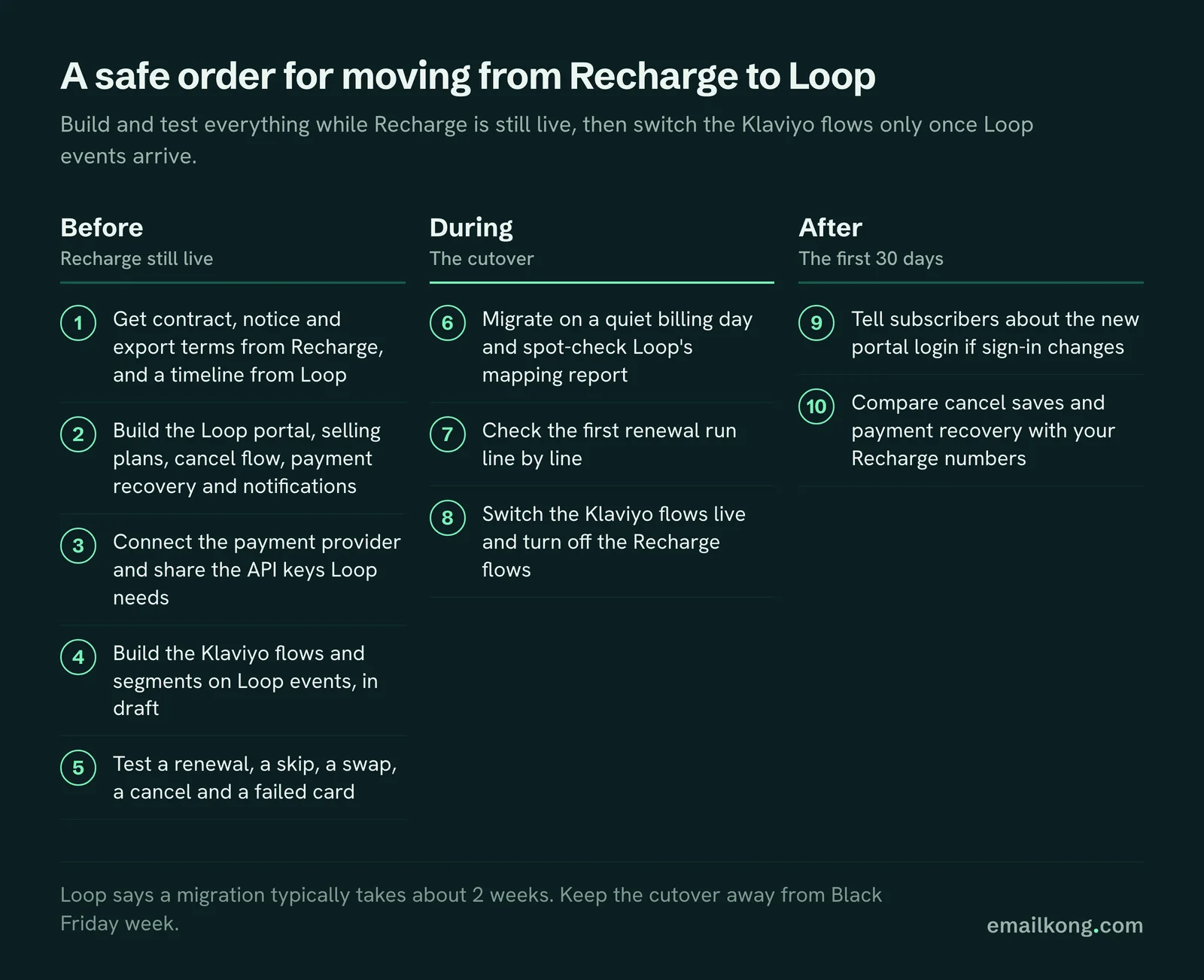
The order we use:
- Get contract, notice and export terms from Recharge, and a timeline from Loop.
- Build the Loop portal, selling plans, cancel flow, payment recovery and notifications while Recharge is still live.
- Connect the payment provider and share the API keys Loop needs.
- Build the Klaviyo flows and segments on Loop events, in draft.
- Test with internal subscriptions: a renewal, a skip, a swap, a cancel and a failed card.
- Run the migration on a quiet billing day, then spot-check Loop's mapping report before confirming.
- Check the first renewal run line by line.
- Switch the Klaviyo flows live and turn off the Recharge flows.
- Tell subscribers about the new portal login if the way they sign in changes.
- Compare cancel saves and payment recovery after 30 days against your Recharge numbers.
EK proof
Email Kong is an official Loop partner and a Klaviyo Master Platinum Partner. 6 brands run subscriptions on Loop with us, and across them "I have enough or too much product" is the #1 cancel reason, at about 23% of cancel attempts in the last 90 days (20,000+ cancel-flow events). Results from 3 of those brands, measured as Klaviyo's share of total store revenue:
- Kaori (women's health): Klaviyo went from 3.3% to 19% of store revenue. Flow revenue grew 17.7x.
- Penrose Skin (skincare): Klaviyo's share went from 15.2% to 23.2%. Flow revenue grew 10.5x.
- KittySpout (pet): 46% of store revenue comes from Klaviyo.